Real-time bidding (RTB) is the sale of one ad impression by live auction while a page or app loads: the publisher describes the impression, buying platforms price it, and the highest eligible bid wins and renders, all inside a few hundred milliseconds. It matters because the unit of purchase has changed: an advertiser pays for one impression judged on what is known about it, and a publisher prices each one rather than selling a block.
EN
RU

What RTB Changes for Media Buying
RTB changes the unit of the purchase. Instead of reserving a block of impressions at a fixed price, an advertiser evaluates and buys each available impression on its own, so what changes hands is the right to show one ad to one person on one screen, once.
Every step of an RTB auction runs machine to machine. For that individual impression there is no insertion order, no rate-card negotiation and no human deciding whether it is worth $1.80 or $2.40 per thousand impressions, though contracts, campaign IOs and deal terms still exist around the auction.
Buyers set targeting, rules and budgets in advance, and software applies them per request, thousands of times a second. None of that inventory ever appears in a media plan.
RTB differs from older bulk buying because it prices inventory impression by impression. Direct and network buying reserved a volume of impressions at an agreed CPM, and the buyer accepted whatever came inside that block. Under RTB two visits to the same page can clear at very different prices, depending on the audience signals, the competing demand, the floor and the campaign rules.
One Impression, Start to Finish
A real-time bidding auction runs in five stages, and all of them finish before the ad slot on the screen is drawn. Nothing in the sequence is negotiated by a human.
| Stage | Who acts | What gets decided | Time budget |
|---|---|---|---|
| Ad call | Browser or app | That an impression exists and needs filling | Page load |
| Bid request | Publisher ad server, SSP or header bidding wrapper | How the impression, page and device are described | Single-digit ms |
| Fan-out | Ad exchange | Which connected bidders receive the request | Single-digit ms |
| Bidding | DSPs and other bidders | Whether to answer, and at what price | Set per request in tmax |
| Auction and render | Ad exchange, then the browser | Who wins, at what price, which creative is served | Tens of ms |
Three constraints decide whether a bid can win: the response deadline, the floor it has to clear, and the eligibility rules attached to the impression. The deadline carries the most weight, because a bid counts only when it arrives inside it.
There is no single industry deadline. Google's bidder documentation puts the response window anywhere from 80 to 1000 ms depending on format and auction type, and tells bidders to read the tmax field on each request instead of hard-coding a number.
On the ADMY exchange the window travels in the tmax field of each request, and the live request we reviewed for this article carries 180 ms. A tight window keeps pages fast for the people loading them and gives each auction to the bidders that can price an impression quickly.
A bidder that does not want the impression returns an empty HTTP 204 response, known as a no-bid. When the auction closes, the exchange calls the winner's notice URL and passes back the clearing price on that call. Under a first-price rule that figure normally matches the winning bid before fees; under other auction rules it can come out lower.
Who Takes Part in an RTB Auction
Four roles appear in every RTB auction: the publisher, its SSP, the ad exchange and the DSP. The publisher owns the ad space, and its SSP packages that space, applies the floor and the rules, and sends the bid request out.
The ad exchange runs the auction and passes the request to connected buyers. The demand-side platform answers on behalf of the advertiser, deciding for each request whether the impression fits a campaign and what to pay for it.
The same company often plays more than one of these roles, which is why the labels often overlap. One group can own both the SSP a publisher sells through and the exchange that runs the auction, so a request can pass through two arms of the same business before it reaches a buyer.
How Many Requests Become Impressions
Only a small share of bid requests ends in a billed impression. Buyers filter most of the incoming stream before reading it, and exchanges limit how much any single bidder receives. Part of the volume is also the same impression arriving by more than one route. A no-bid is the normal answer in RTB, and every system in the chain is built around that expectation.
Two different numbers get called fill rate, and they differ by three orders of magnitude. Which one a report means decides whether the same inventory looks like a fraction of a percent or close to full.
| Metric | Counted as | Typical value |
|---|---|---|
| Bidder-level fill | Impressions won, divided by bid requests one buyer received | Under one percent, up to a few percent |
| Slot-level fill | Filled impressions, divided by ad requests the publisher made | Tens of percent, up to near 100% |
Each of those limits is a design choice. Buyers shape traffic so their server capacity goes to requests they can realistically win, exchanges cap queries per second to keep responses inside the timeout, and by Jounce Media's May 2026 benchmarking the average RTB-enabled publisher integrates with 25 to 30 sell-side platforms, which is why one impression can reach the same buyer by several routes.
Fill rate only means something once you say which one you mean. DataBeat put conventional bidder-level fill at 0.183% in its June 2026 US trends report, a useful benchmark for reading any request-level report.
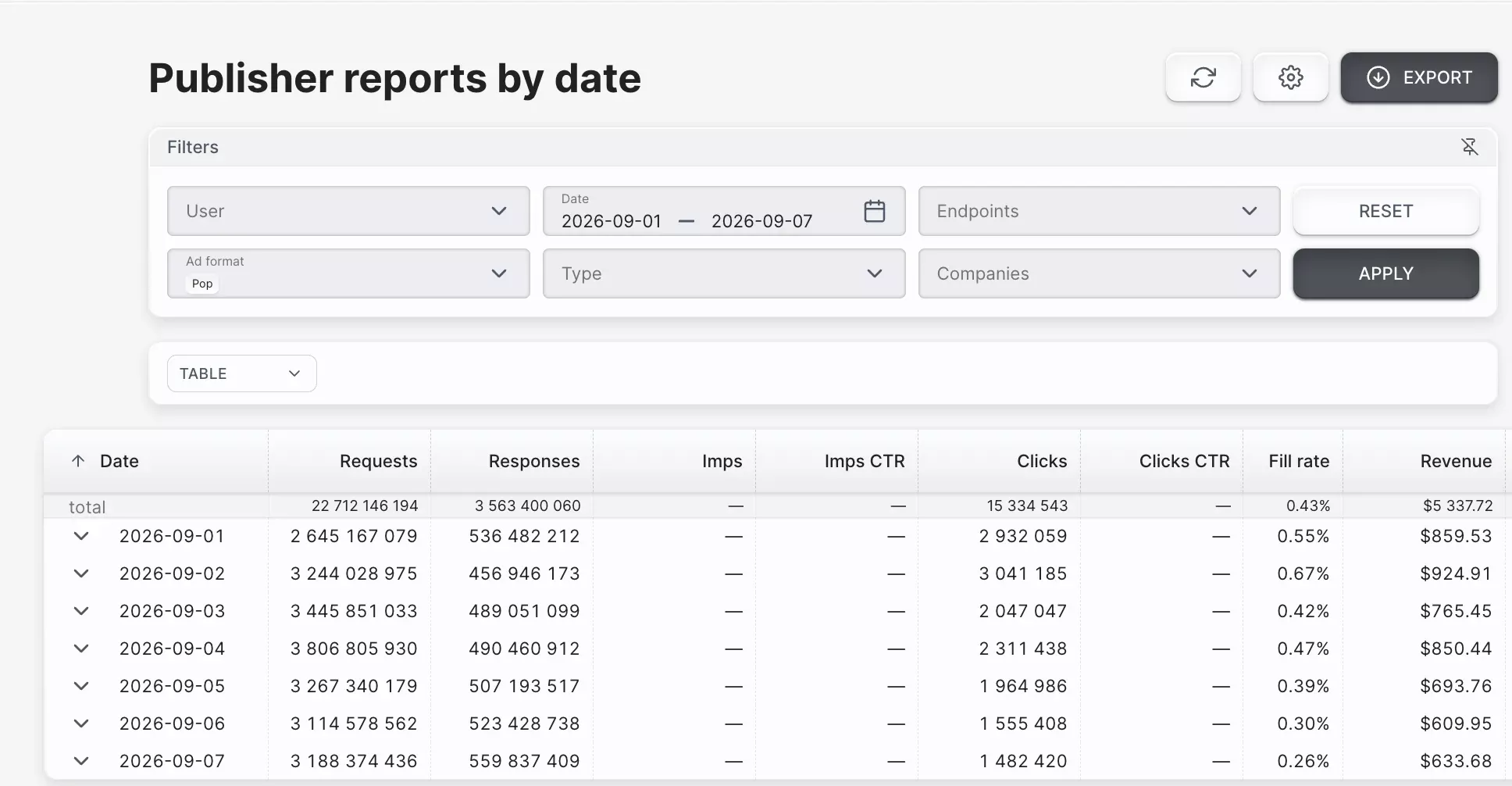
The ADMY publisher report for the first week of September 2026 covers more than 43 billion requests across five formats: fill of 0.43% for pop on 22.7 billion, 0.08% for video on 10.5 billion, and around 0.02% for push, in-page and native. Those are counted our way rather than the benchmark's, and fill tracks each partner's traffic and demand, which is why every launch is tuned to the partner's own setup from the first day.
Inside an OpenRTB Bid Request
An OpenRTB bid request describes the impression on offer, the page or app around it, the device, whatever the seller knows about the person in front of it, and the rules for processing all of that. OpenRTB is the message format most of the real-time bidding market uses for that description, maintained by IAB Tech Lab.
A live request on our exchange is far leaner than the full specification. The one we reviewed for this article carries the impression size and accepted formats, the site, the device with country-level geo, a user ID, an auction type of 1, which marks a first-price auction, and a 180 ms tmax, while the response returns a price, a win notice URL and the creative.

Only the auction id and one impression object are required by the spec. Everything else is optional, each exchange adds its own required fields on top, and the 2.x line ships non-breaking updates monthly under date codes, so two integrations that both claim OpenRTB 2.6 can be a year apart in fields and still need separate work.
| Object | What it carries | Why a bidder cares |
|---|---|---|
| Site or App | Page URL, referrer, app store bundle ID | Brand safety, blocklists, content category |
| Device | User agent, IP address, make and model, carrier, mobile advertising ID, limit ad tracking flag | Format support, targeting, whether tracking is permitted |
| Geo | Latitude and longitude, how the fix was obtained, accuracy in metres, seconds since the fix | Geotargeting precision, and whether to trust it |
| User | Exchange and buyer user IDs where available, external identifiers, audience segments, consent signals | Audience matching, frequency control |
| Regs | GDPR, COPPA and Global Privacy Platform flags | Legal basis for processing |
| Source | Transaction ID shared across participants, supply chain object | Deduplication and supply path checks |
| Impression | Slot sizes, formats, the floor price, blocked categories and advertisers | Whether a bid is possible at all |
The Geo object is where geotargeting gets its precision. Location can come from an IP lookup, from GPS or from another source, and the object records which: IP inference supports country and region targeting, GPS coordinates can be precise to metres, and a buyer that reads the difference pays the right price for the accuracy it gets.
The specification also removes fields over time. Version 2.6 deprecated the year of birth and gender, and notes that calling a field "recommended" describes market habit, not advice to send it.
How the Price Is Set
Three things set what an impression costs in real time bidding: the publisher's floor, the auction rules, and how disciplined the buyer's bidding is. The floor is the minimum a seller will accept for that ad space, and bids below it are discarded before anything is compared.
Display and video moved from second-price to first-price between 2018 and 2019, so the winner now pays what it bid. That is why bid shading exists: algorithms lower a bid toward the level likely to still win, because overbidding is paid in full.
One auction with numbers
Six bidders receive one request, four never compete, and the winner pays $2.80 against a high bid of $4.10. The numbers are illustrative, the sequence is what the protocol describes: a floor of $1.50 CPM, a 200 ms window, six bidders on the call.
| How many | Bid | Response | Outcome |
|---|---|---|---|
| Three | None, HTTP 204 | Within the window | Filtered on pre-bid rules: wrong country, frequency cap reached, domain on a blocklist |
| One | $1.20 | In time | Below the $1.50 floor, discarded before the comparison |
| One | $4.10 | 240 ms | Arrived after the window closed, not counted |
| One | $2.80 | 90 ms | Wins |
The buyer pays $2.80 CPM, and the publisher receives it net of the fees along the way, which the ANA puts at 27.2% of programmatic spend once every intermediary in the chain is counted. Speed decided this auction: the fastest eligible bid won, and the largest arrived after the window. Response latency is a bidding parameter, so budget for it the way you budget for CPM.
What decides the win besides price
Price is one of four things that decide the winner in a real-time bidding auction. A bid also has to arrive inside the timeout, clear the floor, and carry a creative the exchange and the publisher accept, and it competes for whatever booked direct and guaranteed campaigns have not already taken.
The pattern I see most often in the first weeks of a launch is a high bid rate with a win rate near zero, and the first instinct is to raise bids. Targeting width and creative eligibility explain it more often than price does, with latency and floors next, so check those before touching the bid: the win rate usually moves without any extra spend.
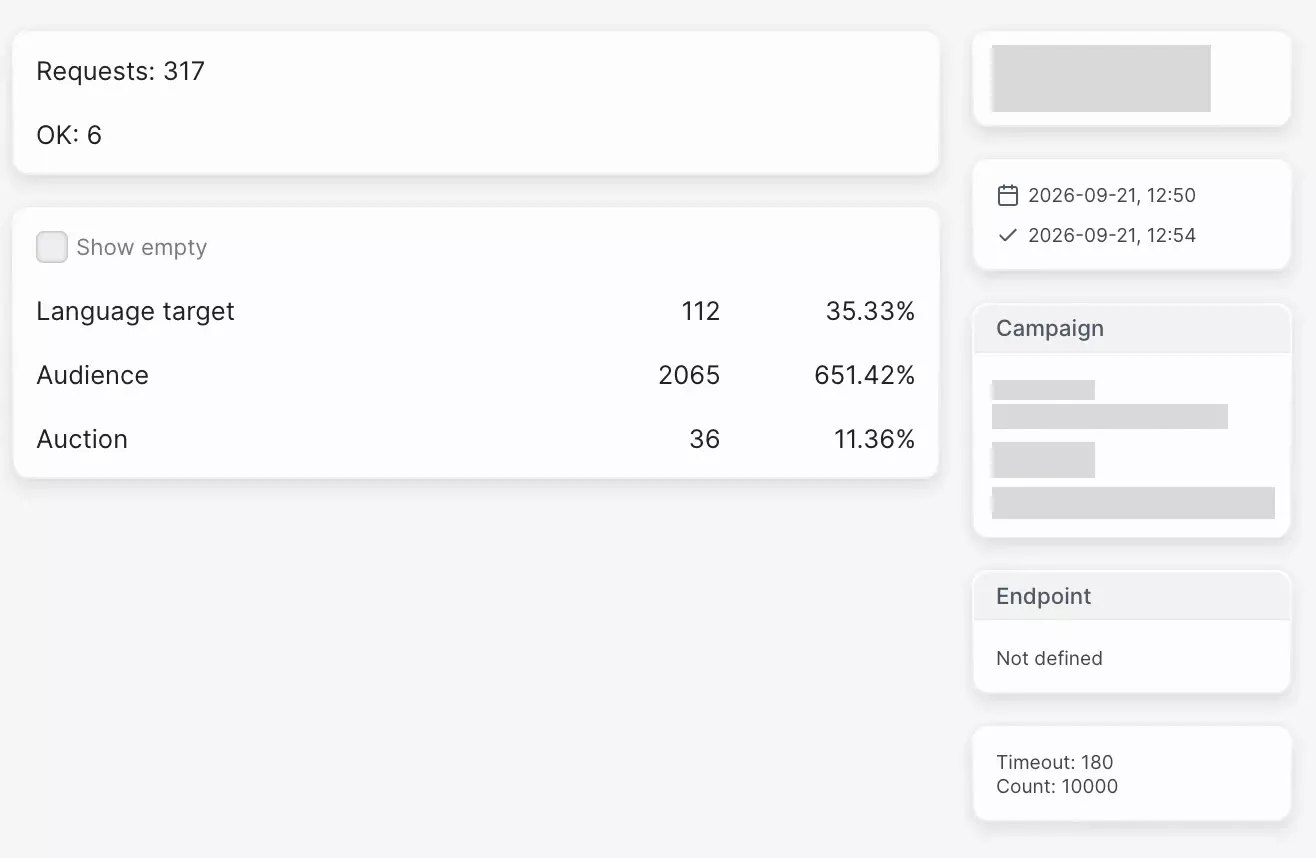
I spent years in support answering this question by hand, which is why campaign analysis on our side now returns the reason directly. It samples incoming requests and shows how many passed and which filter held the rest, whether language targeting, audience or the auction itself, so the fix is visible within minutes.
Floors changed again in December 2025, when Google let publishers set bidder-specific floors once more. The same impression can now carry a different minimum price depending on which path you bid through, which makes supply path choice a pricing decision.
Programmatic Advertising vs RTB
Real-time bidding is one type of programmatic advertising, and the two words are not synonyms. Programmatic covers every automated way of transacting ad inventory, while RTB covers the part that clears through a live auction, impression by impression.
| Deal type | Live auction? | Who sets the price | Who can buy |
|---|---|---|---|
| Open auction | Yes | The auction | Any connected buyer |
| Private marketplace | Yes | The auction, above an agreed floor | Invited buyers |
| Preferred deal | No | Fixed in advance | One buyer, first refusal |
| Programmatic guaranteed | No | Fixed in advance | One buyer, volume committed |
Header bidding is not a fifth deal type. It changes where the real-time bidding auction happens: several demand sources bid in parallel before the ad server decides, instead of being called one after another.
RTB Formats and Channels
RTB advertising covers almost every open-web format: display banners, native placements, in-page units, video, push and pop. What changes between the web and apps is the environment around the auction, not the auction itself.
On the web real time bidding runs through the browser and identity comes from cookies and publisher-provided signals. In apps an SDK triggers the auction, identity comes from the mobile advertising ID, and conversions are usually counted by a measurement partner, so in-app results are best read in that partner's report.
ADMY carries six formats across web and app inventory: pop, push, in-page, native, video and banner. Pop and push sit outside what most large exchanges will take, and ADMY gives the performance advertisers who want them a live auction to buy in.
Where the Budget Goes
45.1% of programmatic ad spend reached a qualified impression in the second quarter of 2026, the highest figure the ANA benchmark has recorded, published in its August 2026 release. The spread matters more than the average: the higher-performing half of advertisers converted 52.3% of spend into qualified impressions against 31.1% for the lower half.
The index counts spend that delivers fraud-free, measurable, viewable and MFA-free impressions. It rose through 2026 on the back of better viewability, while transaction costs settled at 27.2%.
Media quality, not fees, creates the gap between cohorts. Inclusion lists, MFA filtering, supply path discipline and click fraud protection move more money than negotiating a lower take rate.
For a publisher real-time bidding replaces the rate card with a set of levers: floors tuned per format and per geography. Raise a floor and you protect CPM; lower it and you gain fill at a lower price.
What a Bid Request Carries
An RTB bid request carries the page URL, the device, the IP address, a location and whatever identifiers the seller holds. Every connected bidder receives it, including those that end up not buying, and consent governs what each of them may do with it.
Pricing requires description, and the order cannot be reversed: every bidder has to see what it is buying before the exchange knows which of them is buying it. As the US Federal Trade Commission put it, a single auction broadcasts consumer data to potentially dozens of bidders at once, although only the winner serves an ad.
Contracts set what a losing bidder may keep, and regulators enforce them. Google's buyer policies bar a losing buyer from building lists or profiles out of callout data and cap retention at 18 months, and in January 2025 the FTC finalised an order against data broker Mobilewalla for retaining bid request data from auctions it had lost, the first case treating bidstream collection as an unfair practice.
The most effective controls act at the source: send only the signals a buyer needs, keep the bidder list focused, and agree what each partner may retain. That is also why identity work moved toward first-party data.
Running Your Own Platform
Running your own platform starts to pay where you are handing someone else a margin on volume you already control. The test is arithmetic: multiply that volume by the take rate in your contract and set the annual figure against a licence plus the people to run it.
Building the alternative is a permanent engineering commitment: an RTB bidder answering inside the exchange's timeout at its required queries per second, OpenRTB integrations maintained against monthly spec releases, ads.txt and sellers.json support, fraud filtering, GDPR handling, and people on call while auctions run. A licence removes that work and keeps the control.
ADMY is a white label DSP, ad exchange and ad network constructor licensed under the client's own brand and domain, with the auction engine, DSP and SSP integrations, creative review and header bidding included. The licence provides the auction, while the traffic and the advertiser book come from the partner, which is why launches that bring both see results in the first month.
The controls worth owning are the floor, supply path rules, blocklists and the retention terms you impose on partners. On ADMY the operator sets one floor across all requests and each publisher's own minimum arrives in the request, so both sides keep a say in the price.
Frequently asked questions
Do you need a DSP?
You need a bidder, not necessarily your own DSP. It can be an agency platform, a rented seat or a licence of your own, and the work stays the same in all three.
Does RTB work without cookies?
Yes. Page context, device, geo, format and time still arrive in every request, and cross-site audience matching and frequency capping are the two areas to plan around.
Why don't the numbers match?
Because they count different events. A buying platform counts a won auction, an ad server counts a delivered ad, and a verification vendor counts a viewable one, so a small gap is normal and a larger one shows where to look: rendering or a duplicated supply path.
RTB or a direct deal?
A direct deal pays a known CPM on committed volume, while real time bidding pays whatever the auction clears, minus the fees in the path. Small, specific audiences usually do better in direct deals, broad inventory in open competition.

More articles
[All articles]
 Iliya Dowlasov