Retargeting is a form of online advertising that shows ads to people who already visited your site or app and left without converting. A tag records what the visitor did, that visit places them in an audience, and your ads reach that audience elsewhere until the person converts or the window closes.
The pay-off is a cheaper conversion: the interest is on record before you pay for the impression. The same budget brings back more of the visitors you already paid to acquire, and keeps the brand in front of them.
EN
RU

What Is Retargeting and How Does It Work?
What Retargeting Means in Online Advertising
Retargeting is a targeting method layered on top of ordinary ad buying, not a channel of its own: the same inventory, the same formats and the same auction as any other digital advertising campaign, with the audience narrowed to people who already interacted with your brand. That narrowing is the entire difference from cold prospecting. Ad retargeting is the same thing named from the creative side.
It all rests on one technical condition: the ad system has to recognise, on some other website, that this browser is the one that visited your product page yesterday. How reliably that recognition holds up decides how much of your audience you can reach at all, which is why so much of what follows is about identifiers.
Retargeting vs remarketing: why the words get mixed up
The words get mixed up because the largest ad platform named its retargeting product remarketing: Google Ads has treated the two as synonyms for years, so anyone who learned the vocabulary there uses them interchangeably. Most marketing teams draw a line instead, where remarketing means re-engaging known contacts through channels you own, mainly email and CRM, and retargeting means paid ads served to anonymous visitors. Both usages are current, so a brief asking for remarketing can mean either, and it is worth asking which one before you plan the budget.
How Does Retargeting Work
A retargeting campaign runs as a loop with six stages. I spend most of my time on launches, and the technical part of that loop rarely decides the outcome: partners overestimate the setup and underestimate the settings that follow it.
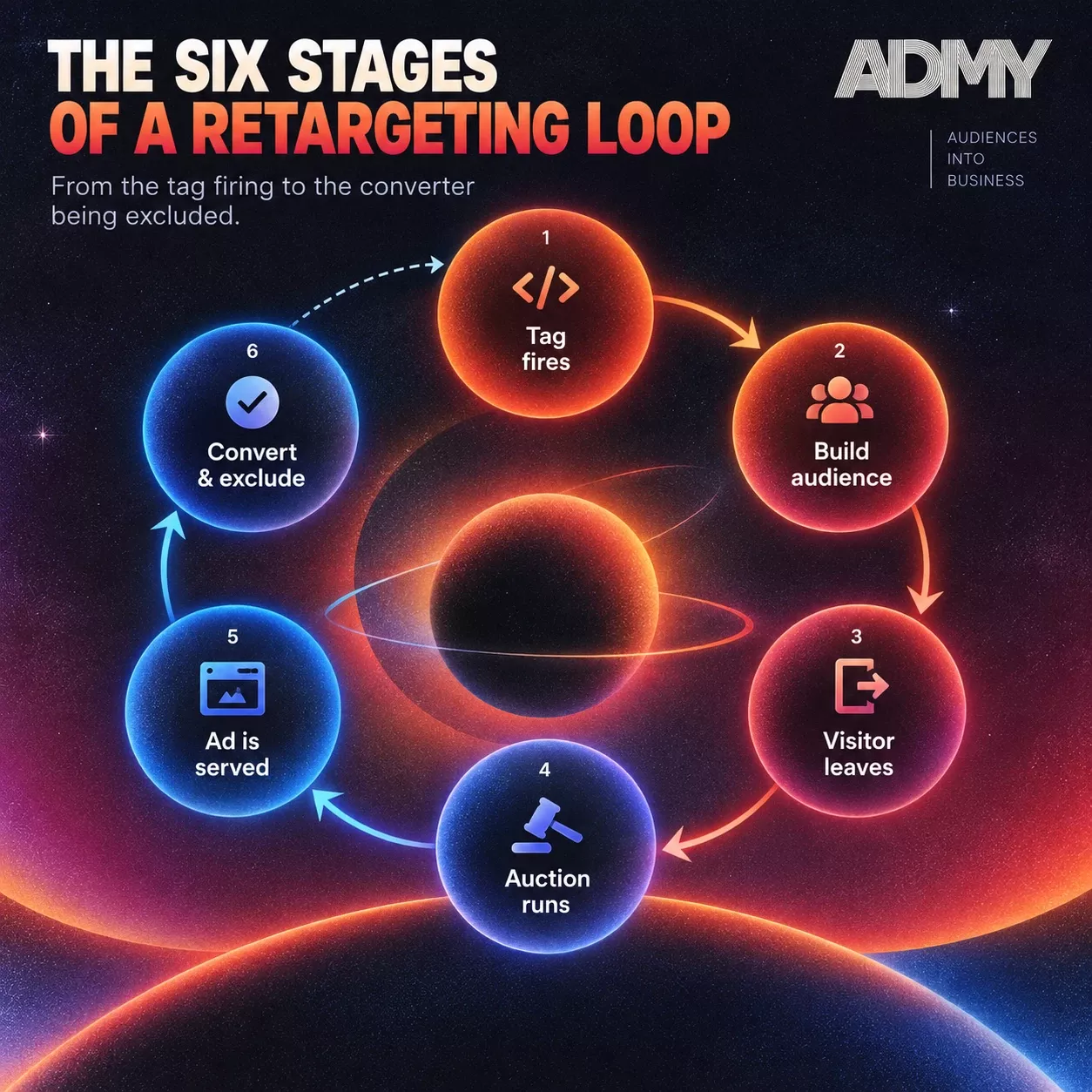
- The tag fires. Code on your site records the page view and any event you defined: product viewed, cart started, form abandoned, plan compared.
- The visitor becomes an audience. The event is written to an audience with a membership window, say everyone who viewed a product page in the last 14 days and did not buy.
- The visitor leaves. On some unrelated site or app, an ad slot loads and your ads become eligible for it.
- An auction runs. The publisher's side sends a bid request describing the impression, and your platform bids if the user belongs to one of your audiences.
- The ad is served. If your bid wins, the creative renders while the page finishes loading.
- The outcome is recorded. A click or a conversion goes back to the platform, the user is capped or excluded, and the loop closes.
In practice: someone compares two plans on your pricing page on Tuesday and closes the tab. On Thursday, reading an article on their phone, they see an ad naming the exact plan they looked at, click, and subscribe. Nothing in that sequence requires knowing who the person is.
What the retargeting pixel collects
The pixel records behaviour: a page URL, an event name, a timestamp, sometimes a product ID and value, written against an identifier stored in the browser. Meta Pixel, the Google tag and the pixel any ad platform gives you all work this way. A name or an email address enters only if you pass one deliberately.
That identifier is what the whole chain hangs on, and it belongs to one browser on one device. Clear the browser, switch devices, or open the site in a browser that blocks third-party cookies, and the same person arrives as a fresh visitor, which is why audience counts usually run ahead of the number of real people behind them.
How the impression gets bought in real time
Between the user loading a page and your banner appearing, an auction has already finished. The publisher's supply-side platform packages the impression into a bid request and sends it to an ad exchange. The demand-side platform holding your audience checks the user against your segments, decides what that impression is worth, and bids. The highest bid renders.
A bid request describes the impression on offer, the page or app around it, the device, whatever the seller knows about the person in front of it, and the rules for processing all of that. OpenRTB is the message format most of the real-time bidding market uses for that description, maintained by IAB Tech Lab.

A campaign therefore lives or dies on the buying setup: audience definition, bid and frequency rules decide whether the right person sees the right ad at a sane price, and all three sit inside the buying platform.
Types of Retargeting: Five Ways the Audience Is Built
Five types cover almost every campaign, split by where the audience data comes from: pixel-based, list-based, search, social and email retargeting. Most campaigns run two or three of them at once.
| Type | Audience source | Who it reaches | Main constraint |
|---|---|---|---|
| Pixel-based | Events on your site | Anonymous visitors | Lives on a browser identifier |
| List-based | Your CRM or email database | Known and lapsed customers | Match rate only visible after upload |
| Search | Search queries | Strangers with intent | No prior relationship with the brand |
| Social | The social platform's own pixel | Logged-in users | Data and frequency stay inside the platform |
| Behaviour in your email campaigns | Subscribers | Ad consent is separate from email consent |
Pixel-based retargeting
Pixel-based retargeting builds the audience from what people did on your site, and the ad reflects that behaviour. It is the default type and what most advertisers mean by the word. Creative comes in two forms: static, where a segment sees one banner, and dynamic, where the ad is assembled from a product feed and shows the exact items the user viewed.
Dynamic wins under narrower conditions than most guides suggest. Anja Lambrecht and Catherine Tucker tested this in When Does Retargeting Work? Information Specificity in Online Advertising (Journal of Marketing Research, 2013): dynamic ads performed worse on average than generic brand ads, and caught up once the user had narrowed down what they wanted.
The study predates dynamic creative optimisation as it works now, so what carries over is the mechanism: the exact product lands best once the choice is narrowed, and a brand message works better while the person is still deciding. Test static against dynamic by funnel stage rather than defaulting to dynamic.
List-based retargeting
List-based retargeting builds the audience from your own customer data: you upload emails or CRM records, and the platform matches them against its users. It is also the only way to reach lapsed customers whose last visit falls outside any pixel audience.
Match rates always come in below the list you uploaded, and the matched size appears only after it. Check it before you plan the budget, because the gap between the list and the reachable audience is where these campaigns quietly shrink.
Search, social and email retargeting
Search retargeting builds the audience from search queries, which makes it the only type that reaches strangers who never interacted with your brand. The intent is real, the relationship is not, so treat it as prospecting with better aim. It sits in this list by convention rather than by definition, since there is nothing to re-target.
Social retargeting runs the same site-visitor audiences inside the large social platforms, on their pixels and their identity graphs. Frequency is the part that catches people out: a cap set in your own buying platform governs only your own impressions, so the two stack on the same person until you cap both.
Email retargeting syncs behaviour from your email campaigns into an ad audience. Consent travels with the data, not with the tag: someone who agreed to receive your emails has not agreed to be targeted with ads, so the sync needs its own legal basis.
Where Retargeting Ads Run and in Which Formats
Four places carry retargeting ads: the large search and social media platforms, the open web through programmatic buying, mobile apps, and increasingly connected TV, or CTV, where there is no click to measure and attribution runs on exposure rather than response. The walled platforms are simpler to start with and keep your data inside their systems; the open web gives you reach outside them, frequency control across the whole campaign, and reporting you can audit.
Format follows placement, and one audience can be reached across channels in a single campaign. Six formats do most of the work: display banners, native units, video, in-page units, push notifications and pop, all six of which carry retargeting audiences on ADMY. The choice matters more than advertisers assume: a push notification an hour after an abandoned cart is a different message from a banner a week later, even with the same offer.
Which Audiences Are Worth Retargeting
The audiences worth retargeting are the ones that left a signal of intent, and everyone else is a cost line. Someone who bounced in four seconds from a mistyped click and someone who read three pages and started a form are both website visitors, and treating them as one audience spends most of the budget on the first group.
Exclusions matter as much as inclusions. Anyone who converts drops out of the audience that moment, existing customers belong in a separate campaign with a different offer, and each segment gets its own creative, since personalisation is the only real advantage the method has over cold buying.
Geography is an exclusion too. When the business serves one city or region, a geographic filter on the same visitor list turns the campaign into local retargeting, where the binding constraint stops being segmentation and becomes the size of the pool a single city produces.
Setting the membership window
The membership window is the setting I see mis-set most often across partner accounts: for one partner a lapsed visitor is still worth pursuing weeks later, for another the opportunity closes within hours. Pull the time-lag report in your analytics, take the 75th percentile of time between first visit and purchase, and round up. If three quarters of purchases land within nine days, the window is ten, not the fourteen that comes with the template.
How big an audience has to be
The audience size sets a floor, and the platform floor is lower than the useful one. Google Ads sets it at 100 active users in the last 30 days across Search, Display and YouTube (checked September 2026). Search used to require 1,000, and any customer list uploaded before 1 February 2024 still has to clear 1,000 matched users until you upload it again.
Eligibility is not readability. A 100-user segment will deliver impressions and tell you nothing, because the floor that matters is counted in conversions rather than users: a few dozen per segment before any comparison means anything.
Frequency capping and ad fatigue
Set a frequency cap per user per day before the campaign launches. On ADMY frequency is left open by default, so the cap is yours to set, and on a small audience it is what keeps impressions per person in a sane range: the budget goes where it can, and that is the same few thousand people. A cap is what keeps the ad a reminder.
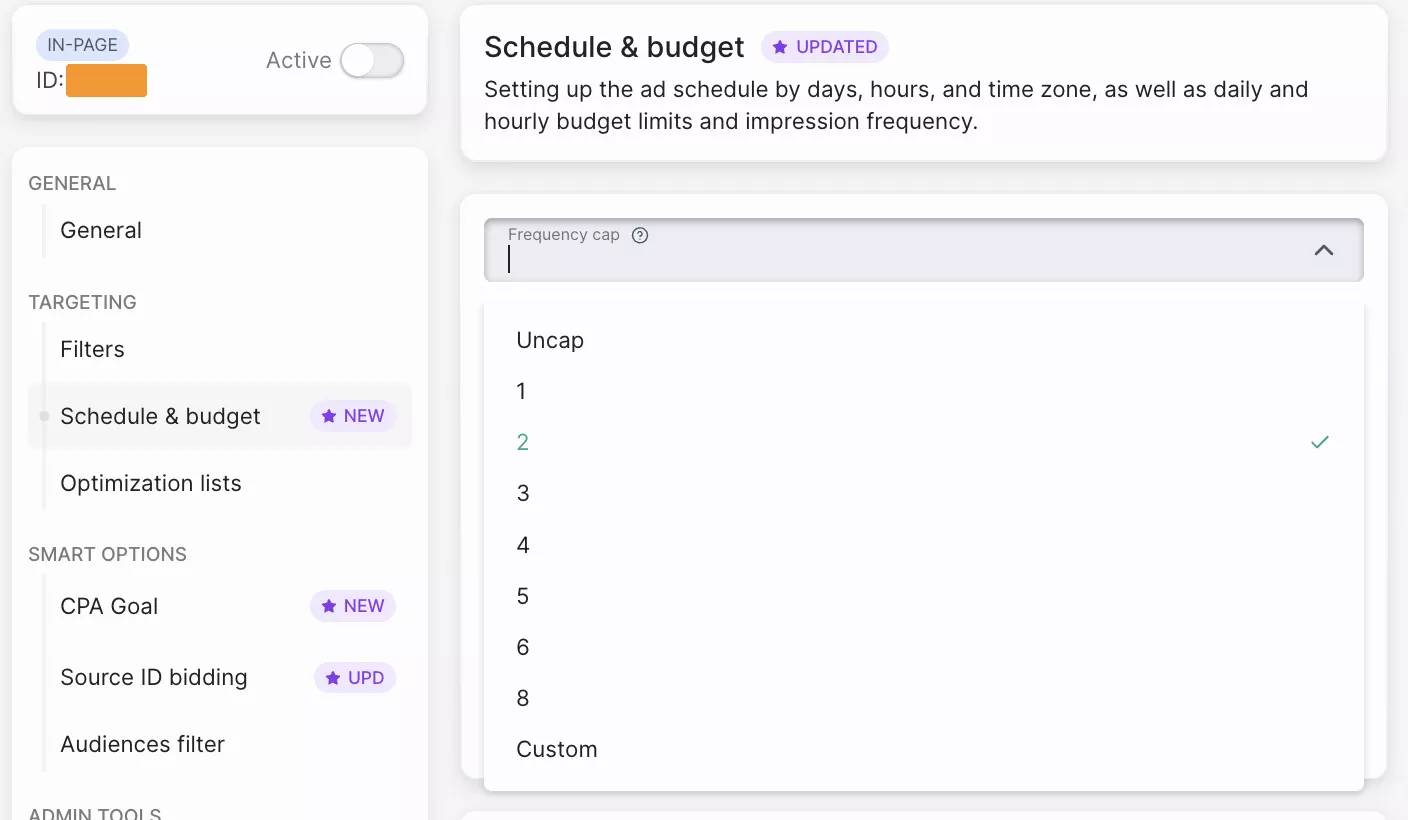
We start partners at two impressions per user per day and raise it to five once a source converts well enough to earn the extra pressure. Start under what you think you need and move up on evidence. Then watch click-through rate by frequency band: the point where the curve flattens is your ceiling. Cap per campaign as well as per user, so impressions from two campaigns stay counted against the same person.
What Retargeting Changes in Your Numbers
The benefits of retargeting are worth taking one at a time, because they are easy to overstate. Cost per conversion against cold traffic usually falls, and the reason is the conversion rate rather than the media price: on the ADMY exchange retargeted traffic costs the same as buying broad, so the saving comes from who sees the ad, not from what the impression costs. Return rate, brand awareness and recall move when the decision window is long enough for a second touch to land inside it. Recall is the one advertisers underrate: where the buyer compares three or four options over a week, being visible for that whole week beats any single clever banner.
The 97% and 50% retargeting statistics have no source
Neither of the two statistics that travel with almost every article on the subject traces back to a published study. The first is that 97% of first-time visitors never return, credited to an unnamed study or to other pages quoting the same line. The second is that retargeting added to existing advertising sells 50% more, attributed to Google with no link. Both work as folklore; plan against your own conversion rate instead.
How to tell real lift from attributed credit
Reporting flatters retargeting, for a structural reason. You are advertising to people who already showed intent, and some of them would have converted anyway. Last-click and last-view attribution credit those conversions to the campaign, which is how it ends up reporting a return on ad spend no other line item can match, and why the ROI quoted in most case studies is attributed rather than incremental.
Splitting view-through from click-through conversions shows how much of the total is which. A view-through means someone saw the ad and converted later without clicking, and on a warm audience that number climbs fast.
The measurement that settles it is a holdout: withhold ads from a random slice of the eligible audience and compare conversion rates. Garrett Johnson, Randall Lewis and Elmar Nubbemeyer ran that test on an online retailer's display retargeting campaign and published it as Ghost Ads: Improving the Economics of Measuring Online Ad Effectiveness (Journal of Marketing Research, 2017). Their holdout put real lift at 17.2% more site visits and 10.5% more purchases, the honest shape of a campaign that worked.
Run one before you scale. Hold back around a tenth of the eligible audience, leave it untouched for a full decision cycle, and read the two groups only once each has produced enough conversions to compare. A campaign with real lift survives that test, and one that was harvesting conversions shows a difference near zero.
Where retargeting does not pay off
Retargeting pays off where the audience is large enough to read and the purchase comes round again. Thin traffic is the first limit, counted in conversions rather than visitors: below the threshold above, one broad visitor audience beats four thin ones. One-off purchases are the second, since the audience goes stale the day after conversion. Long decision cycles are the third, where the window expires before the buyer decides, which is the standard problem in B2B retargeting. And when someone left over price, frequency will not change the answer.
How Retargeting Ads Are Billed
Three billing models cover retargeting in practice, and the choice decides who carries the risk. CPM means you pay per thousand impressions, which suits frequency and recall objectives and leaves delivery risk with you. CPC means you pay per click and moves part of that risk to the supply side. CPA means you pay per conversion, which sounds safest and is the model supply partners price most defensively, because it makes them carry your funnel as well as their own traffic quality.
Retargeted inventory usually carries a premium, because demand concentrates on a small pool of users and several advertisers bid for the same person. How large that premium is depends on where you buy, and on some supply it disappears entirely. Check what your own supply charges before you budget a markup.
If you would rather hand the pixel, the audiences, the creatives and the buying to someone else, that is the shape of full-cycle retargeting as a service: ADMY runs the strategy, produces and tests creatives and manages campaigns on its own side, with a separate admin panel for the client and a launch in two to three days. The iGaming retargeting case, where reactivation matters more than acquisition, works the same way.
Retargeting Without Third-Party Cookies
Retargeting still works without third-party cookies, on a smaller audience and with more setup. Cookies decide who the ad system can recognise and consent decides who it is allowed to record, so between them they set how many of your visitors ever make it into a retargeting audience.
Third-party cookies still work in Chrome and there is no removal date, after Google abandoned the phase-out and retired most of the Privacy Sandbox APIs built to replace them in October 2025. Safari, Firefox and Brave block them by default, and Safari and Firefox alone took close to a fifth of worldwide page views in August 2026 by Statcounter's measurement. That is the rough ceiling on how much of the open web a third-party pixel never reaches, and consent refusal cuts into what is left, so the two losses add up rather than overlap.
Consent decides the rest. Some markets require it before the pixel writes anything, as GDPR and the ePrivacy Directive do, others let you track until the user opts out, as CCPA does, and in both cases the consent banner is what stands between a visit and an audience. So the audience you can address is always smaller than your traffic: some visitors are never tagged, and the same person on two browsers arrives as two. That is why campaigns lean on first-party identifiers, server-side tagging and platform-side matching, and why the walled platforms hold up better here than the open web.
Inside mobile apps the identifier is not a cookie at all. iOS uses the IDFA and Android the GAID, and since App Tracking Transparency arrived on iOS, an app has to ask permission before the IDFA can be shared, which is why app retargeting on iOS runs mostly on aggregated and on-device signals rather than on a user-level identifier.
Frequently asked questions
Is retargeting still effective?
Yes, with a smaller reachable audience than five years ago. Consent rates and browser identifier limits shrink how many of your visitors you can actually address, so the same campaign reaches fewer people at a similar cost per conversion. Where it stopped working is in unsegmented campaigns aimed at every visitor.
How do you stop retargeting ads from following you?
Clear the browser's cookies for the sites involved, then turn off personalised advertising in the ad settings of the platforms you use: the audiences you sit in stop being refreshed. Browsers that block third-party cookies by default, and private browsing, prevent most of it from starting. The ads do not stop entirely, they stop being about the product you looked at.
How long before a retargeting campaign shows results?
Give it one full decision cycle plus the length of your audience window, then read the numbers. Clicks appear on day one, but a purchase that normally takes a week to decide will take a week here too, and a verdict reached earlier than that is noise. The slower part is audience volume: a segment refills at the speed of your traffic, so a site with modest traffic waits weeks for enough conversions to compare anything.
Why do I keep seeing ads for a product I already bought?
Because the advertiser did not exclude converters from the audience, which is the most common setup error in retargeting. A correctly built campaign drops you the moment the purchase is recorded and moves you into a different one, with an offer that makes sense for someone who already owns the thing.
What is the difference between retargeting and a lookalike audience?
Retargeting reaches people who interacted with you; a lookalike audience reaches strangers who resemble them. The platform takes your customer or visitor list as a seed and finds users with similar behaviour, which makes it an acquisition tool rather than a return tool. The two are often run together, with the lookalike bringing new visitors in and retargeting catching the ones who leave without converting.
What is the difference between retargeting and display advertising?
Display advertising is the format, retargeting is the targeting. A display banner can be shown to anyone the campaign targets, including people who have never heard of you, and it becomes retargeting only when the audience behind it is built from people who already visited. That is why retargeting runs on display, native, video, push and in-page alike.
What is an example of a retargeting ad?
The classic retargeting ad is a banner showing the exact item you left in a cart, sometimes with a discount. Others: a plan comparison shown to someone who visited a pricing page, or a push notification after an abandoned sign-up.

More articles
 Iliya Dowlasov