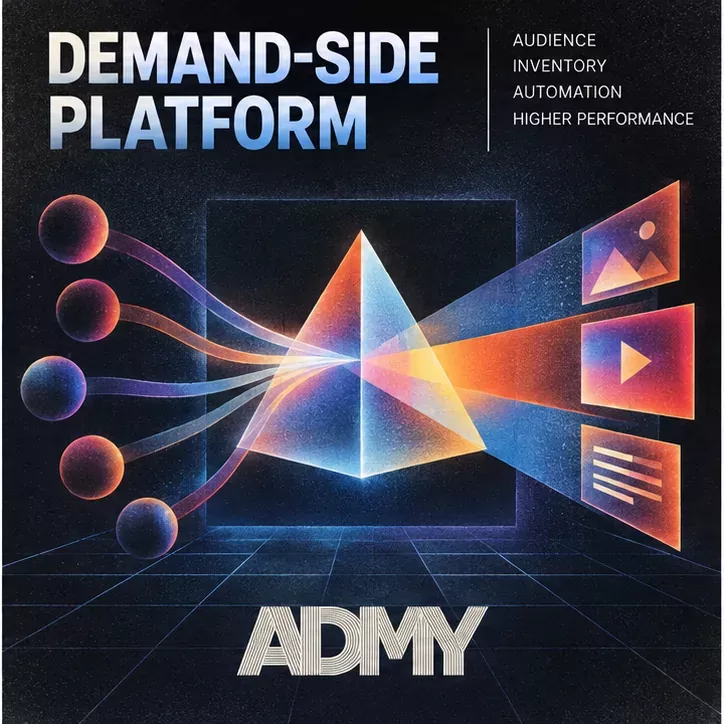
A white label DSP license includes a ready-made demand-side platform under your own brand and domain, with the provider running the bidder, supply connections, reporting and support. At ADMY, the white label advertising platform goes live within 24 hours, and the first paid campaign starts once your supply setup, billing and test requests are confirmed. Your company signs advertisers and sets the margin, so the license begins generating revenue as soon as your sales team closes deals. Below, I explain what remains on your side, how pricing is structured, and the common integration errors I see before launch.
EN
RU

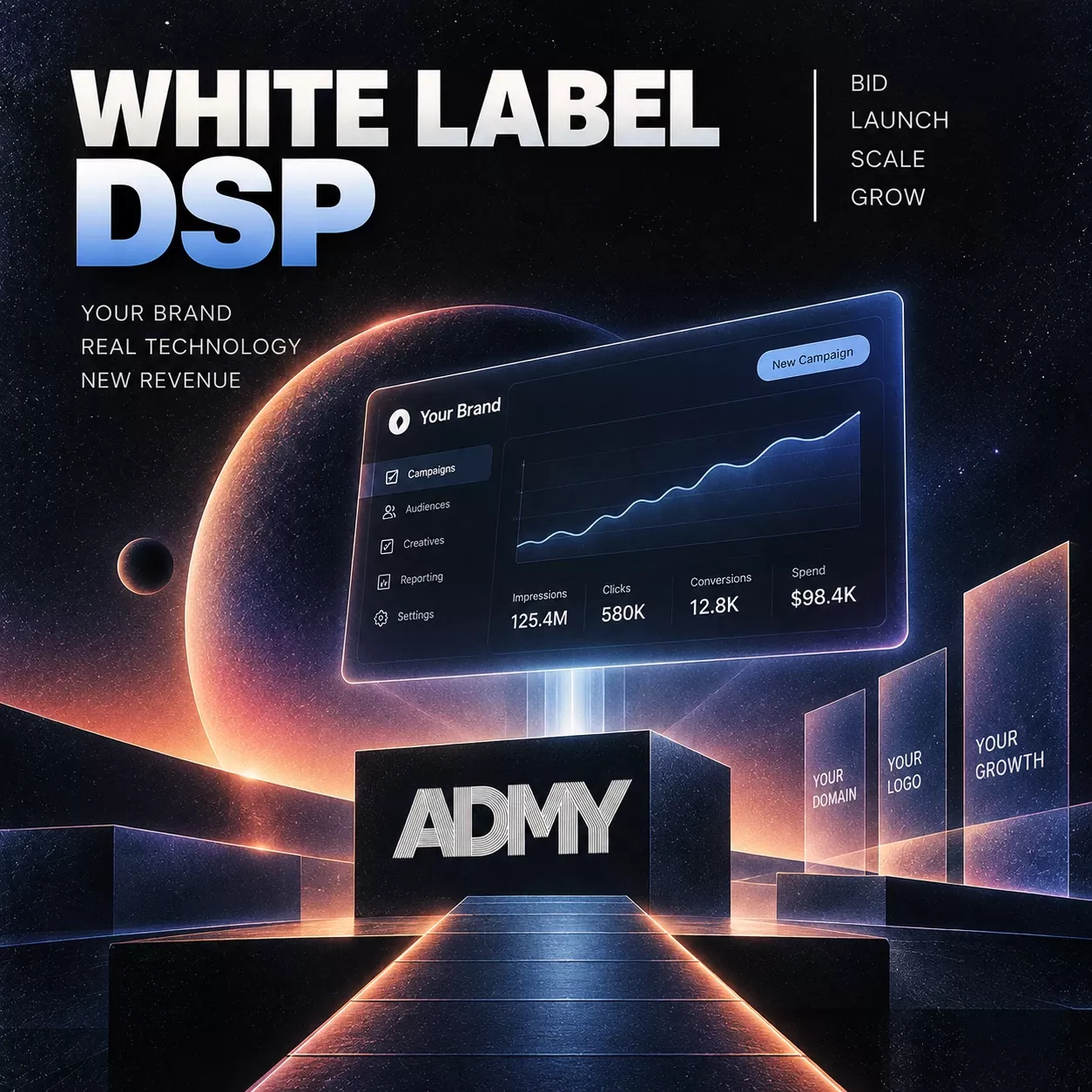
What a White Label DSP Is
A white label DSP is a demand-side platform built and run by one company and sold by another under its own name. The provider maintains the servers, the bidder and the connections to ad exchanges. You, as the licensee, bring the advertisers, set the prices and look after your clients. They log in to a platform with your logo on every screen, which is the main difference between white label DSPs and a shared self-serve account.
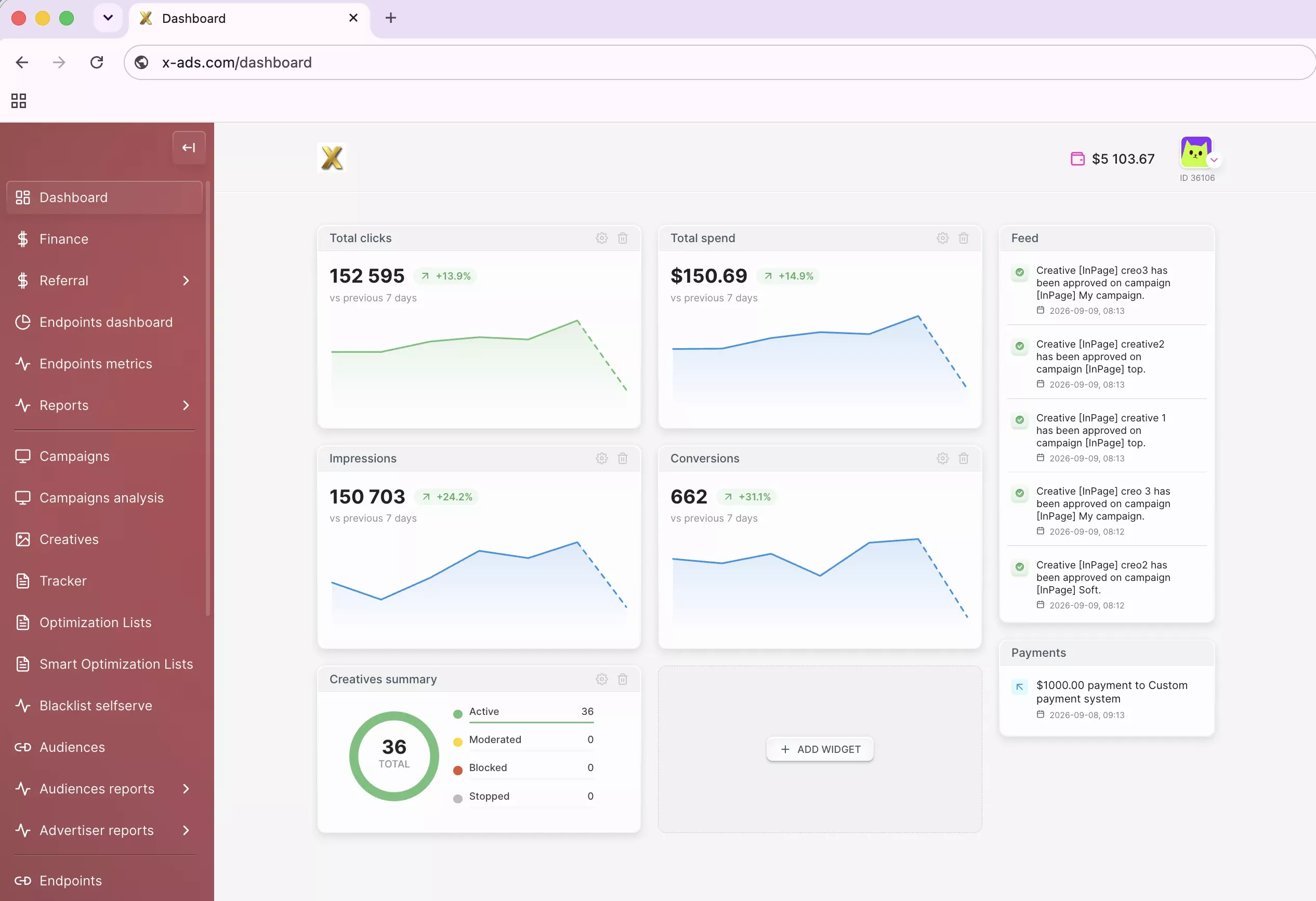
An ADMY license lets you run the platform under your own brand and sell media buying to your advertisers. The license is non-exclusive, non-transferable and revocable, and the code stays with the provider. Your advertiser contracts and your margin belong to you.
| Question | Short answer |
|---|---|
| What the license includes | Campaign management, a real-time bidding engine, supply connections, reporting, creative management, technical operations and 24/7 support under your brand |
| What stays on you | Advertiser sales, billing, extra supply deals, ads.txt and sellers.json records, your content policy |
| How it is priced | A mix of setup fee, monthly license, revenue share on spend and usage fees |
| Launch time | Platform online within 24 hours at ADMY; first paid campaigns follow once supply and billing are confirmed |
White Label vs Self-Serve DSP
A white label DSP and a self-serve DSP give you the same bidding tools, and the difference is whose brand your clients see. A self-serve account sits on another company's platform, so you work under its brand and pay its fee on top of your media spend. Full service goes one step further: the vendor's team also runs the campaigns for you.
To choose a white label DSP over the other two options, look at who your clients are. This model suits agencies with several clients, ad networks that want their own technology and entrepreneurs starting their own ad business. A white label DSP for brands makes sense when an in-house team spends at volume and wants all accounts and fees under one company. Publishers usually need the supply side instead, which the SSP section below covers.
| Model | Brand your clients see | Who runs campaigns | Who sets platform pricing |
|---|---|---|---|
| Self-serve DSP | The vendor's | Your team | The vendor |
| Full-service DSP | The vendor's | The vendor's team | The vendor |
| White label DSP | Yours | Your team or your clients | You |
What the License Includes
An ADMY white label DSP license includes everything needed to buy media under your own brand: campaign management, a bidder connected to supply, reporting dashboards and 24/7 technical support. The branded advertising platform runs on your domain, and your logo and colors appear on every screen, from the login page to the reports.
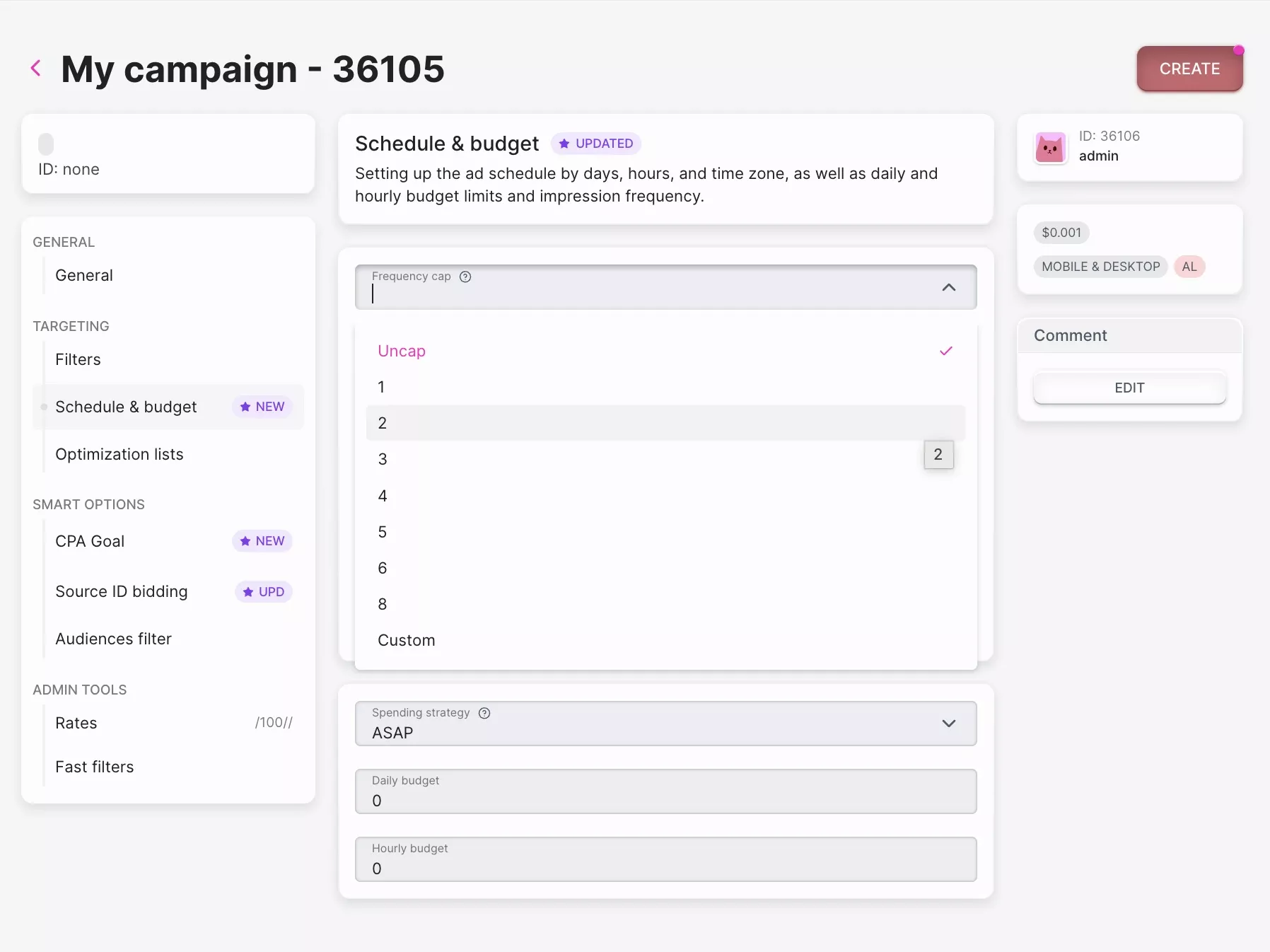
Each campaign has its own settings for format, targeting and frequency. The format is the first step and cannot be changed after the campaign is created, so a push campaign stays push until you create a new one.
| Component | What it does |
|---|---|
| Campaign management | Advertisers create, fund and control campaigns in a branded advertising platform |
| Bidding engine | Real-time bidding with automatic bid optimization toward each campaign goal |
| Supply access | Global inventory through integrations with major DSPs and SSPs |
| Creative management | Upload and control of creatives inside the platform |
| Reporting dashboards | Campaign statistics for you and for every advertiser account |
| Ad formats | POP, push, in-page, native, video and banner |
The frequency cap is set by hand in the campaign settings, because the platform applies a limit only after you enter one. The field sits in the Schedule & budget step next to the daily and hourly budget, and it stays on Uncap until you choose a value from the list or enter a custom one.
Supply decides how much a white label programmatic advertising business earns, and fill on the ADMY exchange varies strongly from one client to another. Before you promise volume to a client, run a test on their traffic and check the result in your reports. This applies to every format, from push to programmatic video advertising.
When a campaign spends less than expected, I open campaign analysis first. The report shows which targeting filters blocked each request, so a vague complaint about low volume turns into a specific setting to fix.
What Stays on You
Sales, billing and compliance stay on your side after you license a white label DSP. The provider gives you the technology and ready supply connections, and finding advertisers is your job. Billing and contracts run through your own legal entity: you invoice advertisers, collect deposits and pay the taxes.
Your advertisers will also expect clean supply. Buyers check supply paths through ads.txt and sellers.json, two IAB Tech Lab standards that show which companies may sell a publisher's inventory. If you also sell inventory under your own brand, publishers must list your seller ID in their ads.txt file.
Content rules are shared with the provider. The ADMY terms list illegal products, IP infringement, adult content, alcohol, tobacco, online gambling ads, weapons, malware, phishing and discriminatory material as non-acceptable business. Fraud is prohibited, and proven cloaking lets the provider ban the advertiser account and hold its balance, so your own advertiser terms should be at least as strict.
Integration Errors Before Launch
The errors I see most often before a white label DSP launch are two empty or missing fields in bid requests and one misnamed postback parameter. They appear when a licensee connects its own traffic sources: my team sets up the platform, and the partner builds the bid requests on its side.
Push partners often send the subscription date empty or leave it out, and many partners do the same with the referrer. The subscription date tells buyers how fresh a push subscriber is. The referrer tells site-targeted campaigns where the ad will appear.
The third error sits in the postback. The ADMY platform sends a click ID with each click and expects it back in a parameter called clickid, while partners often return it as click_id. When the name matches, every conversion appears in the report and the bidder can optimize on it.
How Pricing Works
White label DSP pricing is built from up to four charges: a setup fee, a monthly license, a revenue share on media spend and usage fees, such as fees per query volume (QPS). Providers combine them differently, so the real cost is the monthly price plus everything charged on top. Paid integrations, extra seats and traffic above the plan limit are the usual extras.
Your margin is the difference between what advertisers pay you and what you pay for media and the provider's share. Take illustrative figures: an advertiser deposits $10,000, you spend $7,000 on media, and a 10% revenue share costs $1,000. You keep $2,000 before your own sales and support costs, so before you choose a white label DSP, ask each provider for a written list of everything charged on top of the monthly plan.
Launch Timeline and Checklist
At ADMY a white label DSP goes live within 24 hours, and that covers the platform itself: the instance, your brand, your domain and user access. The first paid campaign takes longer, because it depends on your side: confirmed traffic sources, test requests, billing and approved creatives.
| If this applies to you | Do this before the first paid campaign |
|---|---|
| You bring your own supply partners | Send a test bid request before live traffic |
| You track conversions | Send a test postback and find the conversion in the reports |
| Advertisers prepay | Set up deposits and payment terms in your own legal entity |
| You sell push or pop | Agree on frequency limits with each client and set the cap manually on every campaign |
| Clients buy banner, native or programmatic video advertising | Run test campaigns in these formats before promising volume |
Run these checks on the day the platform goes live, before the first advertiser pays for a campaign. You can see the admin side in a demo on the ADMY platform page before you sign.
White Label DSP Provider Checklist
Choose a white label DSP provider by five things that decide your margin and your freedom to leave: supply, formats, pricing, data and contract terms. Most providers list similar features, so these five are where offers really differ.
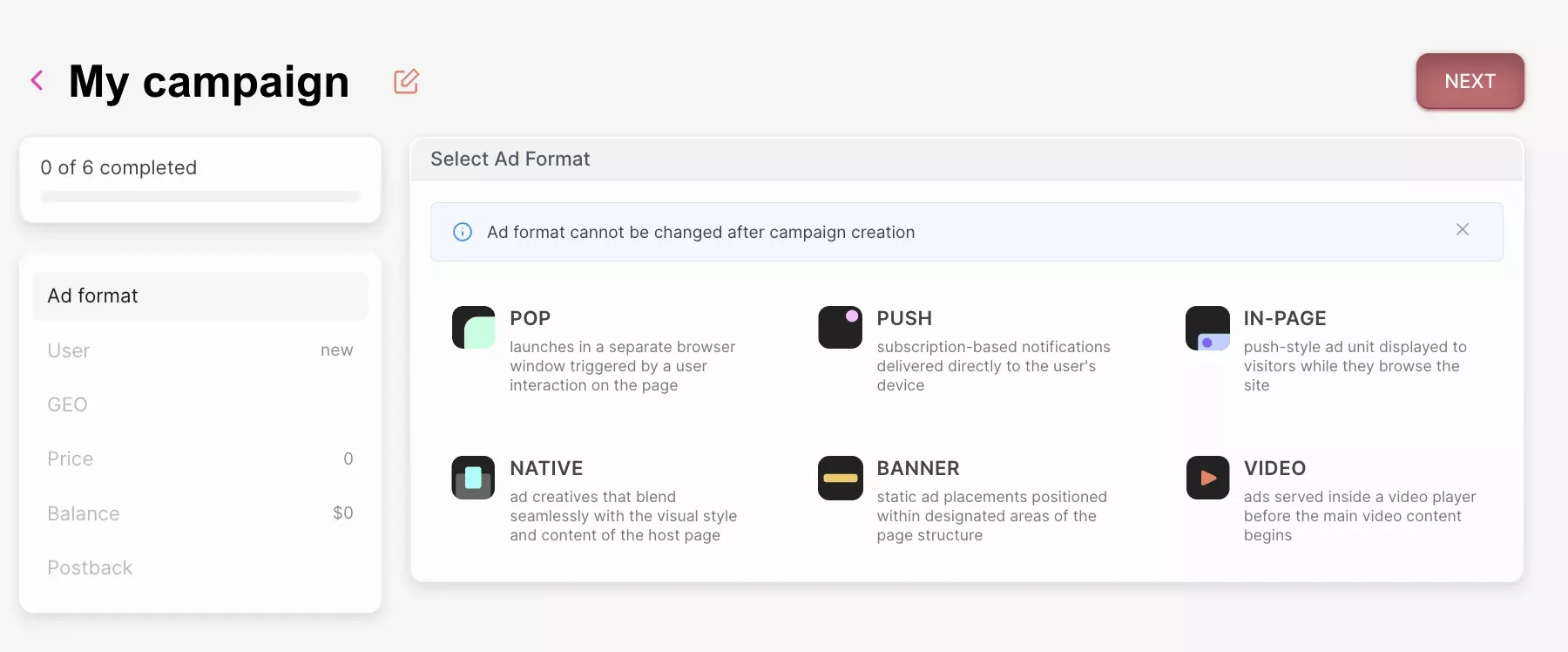
Start with supply: ask for fill by format on traffic similar to yours and for the bidder timeout. Then check formats. ADMY supports six, pop, push, in-page, native, video and banner, so agencies selling streaming TV or audio need a platform built for those formats.
Next, ask each provider to list the setup fee, monthly license, revenue share and usage fees in writing. Then ask which campaign, audience and report data you can export, and in what format. Finally, read the contract: the notice period, the revocation clause and what happens to advertiser balances if the contract ends.
DSP, SSP, Exchange or Ad Server
You need a demand-side platform (DSP) if you sell to advertisers, an SSP if you sell publishers' inventory, an ad exchange if you connect both sides, and an ad server if you run direct campaigns on sites you control. Each tool covers a different part of the ad tech stack, so pick the one that matches where your clients are.
A white label ad server is the simplest option. It places direct campaigns on your own sites or on sites you sell for, which suits publishers who sell mostly through direct deals. Once you add programmatic demand, you move on to an SSP, an exchange or a DSP.
When you need an SSP
A white label SSP is the right choice when you earn by selling publishers' inventory to buyers. A white label supply side platform onboards publishers, sets floor prices, runs header bidding and sends each impression to demand partners. At ADMY this sits in the Ad Network Constructor, which handles publisher onboarding, creatives, direct deals and header bidding under your brand.
Media holdings with several sites and ad networks with their own publishers usually choose this setup. On the exchange, the publisher's minimum price comes in the bid request, and one floor applies to all buyers.
When you need an exchange
You need a white label ad exchange when you want to run auctions between many buyers and many sellers on your own platform. The exchange runs real-time bidding auctions, gives publishers and advertisers their own reporting dashboards, and supports direct deals and guaranteed campaigns alongside open auctions.
This setup suits networks that already work with both advertisers and publishers. The ADMY version adds analytics, custom dashboards and flexible reports, so each side sees its own numbers.
Build Your Own Ad Network
Building your own ad network from scratch makes sense when the technology itself is the product you want to sell. You have three options: build your own ad network, license a ready-made platform, or rent an account on someone else's demand-side platform. Renting is the cheapest start, and the product stays with the vendor. Building gives you full control and takes months of engineering before any revenue.
Licensing is the middle option. A licensed white label DSP gives you a platform under your own brand in a day, and the provider handles engineering, infrastructure and on-call support.
What building requires
Building requires a bidder that responds within the exchange timeout, around the clock, at whatever request volume your supply sends. The timeout comes in each request as tmax, in milliseconds, so your servers must sit close to the exchanges, and every integration must use OpenRTB, the standard protocol for real-time bidding.
You also need ads.txt and sellers.json support, ad fraud detection that filters bots before you pay for them, consent handling for GDPR traffic and an on-call team for the night an exchange changes its endpoint. All of it has to work from day one.
The ADMY stack is built to handle billions of requests per day, and with white label DSPs that part of the ad tech stack stays with the provider. If you run your own ad business on a self-built bidder, ad fraud detection and on-call cover keep costing money long after launch.
Frequently asked questions
Do You Need Technical Skills?
Yes, at one stage: the supply integration, when partners' bid requests and postbacks have to match the platform's format. Day-to-day work on an ADMY white label DSP platform falls to media buyers, and the provider keeps the technical side.
Is White Labeling Illegal?
White labeling is legal: it is a licensing contract under which you run a provider's technology under your own brand. The public ADMY terms reserve resale of the software itself to the provider, so have a lawyer check that your signed agreement covers access for your advertisers.
How Do Demos Work?
You request a demo with the Demo button on the ADMY site, and the form asks for your name, company, email, Telegram contact and a short comment. The demo shows the admin side of the white label DSP platform before you sign anything. Bring your questions about supply, formats and pricing for your own traffic, because the answers depend on your case.
Is Your Data Shared?
Yes, within the limits of the ADMY privacy policy, and personal data is not sold. Data can be passed to group companies, insurers, professional advisers and, when required, government bodies and law enforcement. It is kept as long as its purpose and the law require, and cookie consent is requested on the first visit to the site.
What Is a Seat?
A seat is a buyer account on a DSP that lets its owner bid in auctions and run campaigns. Renting a seat means buying through another company's platform under that company's brand and terms. With a white label DSP you issue seats to your own clients, and some providers charge for each extra seat above the plan, so ask how many seats the license covers.
Can You Add White Label Retargeting?
Yes, ADMY Retargeting is a turnkey white label retargeting product with its own pixel, a client admin panel and a 2-3 day launch. Retargeted inventory costs the same as broad targeting, so it works as an add-on to a white label programmatic offer. It fits brands with steady site traffic, because retargeting needs past visitors to show ads to.

More articles
[All articles]
 Iliya Dowlasov