Local retargeting works by combining two conditions: the person has visited your site, and is currently located within your service area. A pixel collects those visitors, a city or region filter keeps only those nearby, and your ads then reach this audience across other sites. Traffic sets the ceiling. The audience is built from past visitors, so the more people land on your pages, the larger the pool you can retarget.
EN
RU

What Makes Retargeting Local
Retargeting becomes local through one geographic filter placed on a visitor list you already own. The same thing gets sold as geo-retargeting or location-based retargeting. The pixel, the auction and the ad formats stay the same as in a national campaign. Local advertisers build that filter in three ways.
A city or radius layer over the whole visitor list is the simplest local filter, and platforms differ on how fine it goes. Splitting visitors by page goes a level deeper, so a site with a page per region turns each page audience into its own segment. The third option starts from the service zone you already work with. If that zone is narrower than the smallest unit a platform can target, you buy the whole unit and accept the spill.
Geo-retargeting and geofencing
Geo-retargeting and geofencing get sold under one banner and do opposite things. Geo-retargeting narrows a pool of people who already visited your site. Geofencing draws a boundary around a physical place and serves ads to the devices entering it, most of them strangers to your brand. That makes geofencing a prospecting tactic wearing a retargeting label.
The gap between the two shows up in the bill. Drawing a geofence around a competitor's location is a standard local pitch, and it buys cold impressions at cold-traffic prices and cold-traffic conversion rates. A list of past visitors is smaller by orders of magnitude, and every impression on it reaches someone who has already been on your site.
Geo-retargeting and geofencing can run side by side when the budget allows it. Comparing their cost per lead as if they were one tactic is how local advertisers end up cutting the campaign that was working.
The Audience Size That Makes It Work
Local retargeting becomes possible at a hundred people on the list, the floor the ad platforms enforce. In December 2025 Google standardized its minimum at 100 active users in the last 30 days, across all its networks and segment types. Meta applies the same floor to a Custom Audience. Those two figures belong to Google and Meta, and an exchange will have a threshold of its own worth establishing up front.
Site traffic is the first thing I check before taking on a retargeting client at ADMY. Creative and segments can be tuned while a campaign runs, and caps can move any day of the week. The list is the exception, because it is assembled from people who already came to the site.
Counting your own pool
You can size your own pool in five minutes in Google Analytics or any equivalent tool. Take unique visitors for the last 30 days, then subtract everyone lost to consent refusals and ad blockers, plus browser limits on cookie lifetime where the pixel uses one. No pixel records every visitor, whatever a vendor page promises. What survives is roughly what a 30-day list holds.
Take an example site with 1,200 unique visitors in 30 days. Lose a quarter of them along the way and about 900 people remain on the list, comfortably clear of both platform floors. The 25% here is a placeholder: your own consent banner reports the real share, and it moves with country and audience.
The window is the lever that grows a pool without new traffic. A 90-day or 180-day list holds several times what a 30-day one does, and the extra people are correspondingly further from the moment they were interested.
When Local Retargeting Fails
Four situations settle local retargeting before the first ad runs, and all of them sit in the list rather than in the creative. Each one is visible in advance, which makes them cheap to check.
| Situation | What goes wrong | What to do instead |
|---|---|---|
| Fewer than 100 people on the list | The segment does not activate, or serves too thinly to read | Widen the window, and build site traffic first |
| Visitors who sign up inside the first session | There is no return trip left to catch | Put the money into first-touch channels |
| Traffic that never loads a page carrying the pixel | No visitor is recorded, so the list has nothing in it | Route that traffic through a page you control |
| A target area narrower than one city | You buy the whole city to reach a fraction of it | Accept the spill, or pick publishers concentrated there |
Traffic that skips your own pages is the easiest of the four to miss. A campaign can send thousands of people to a partner page or a store listing, and none of them reach the pixel. The list stays exactly where it was, whatever the media budget was.
Where Local Retargeting Ads Run
Local retargeting runs wherever an exchange holds inventory in your city. In practice that means display banners, native units, in-page placements, video and push, plus the social platforms. ADMY supports six formats: POP, push, in-page, native, video and banner.
Format choice matters more on a small list than a large one. I treat pop and push as the fast burners. Both can put several impressions in front of one user inside a single session, so a few hundred people are covered within days. Native and in-page stretch the same budget over a longer run.
What the creative should carry
The first thing the creative should carry is the place. Name the city or the region in the copy itself, because a message pitched at a whole country reads as generic to someone who was on your site last week. The local name is the cheapest way to make an ad look addressed to one person.
Currency and payment work the same way. Quote the price in what people actually spend, and show the methods that clear in that market rather than the ones on your global page. Timing counts too: serve the ad in the audience's evening instead of yours, and give the offer a deadline in their time zone.
Frequency and Budget on a Small Pool
On a small pool the frequency cap sets the budget, because the pool multiplied by the cap is every impression there is to buy in a day. The ADMY platform ships with no frequency cap by default, so I set one by hand on every retargeting campaign: two impressions per user per day at the start.
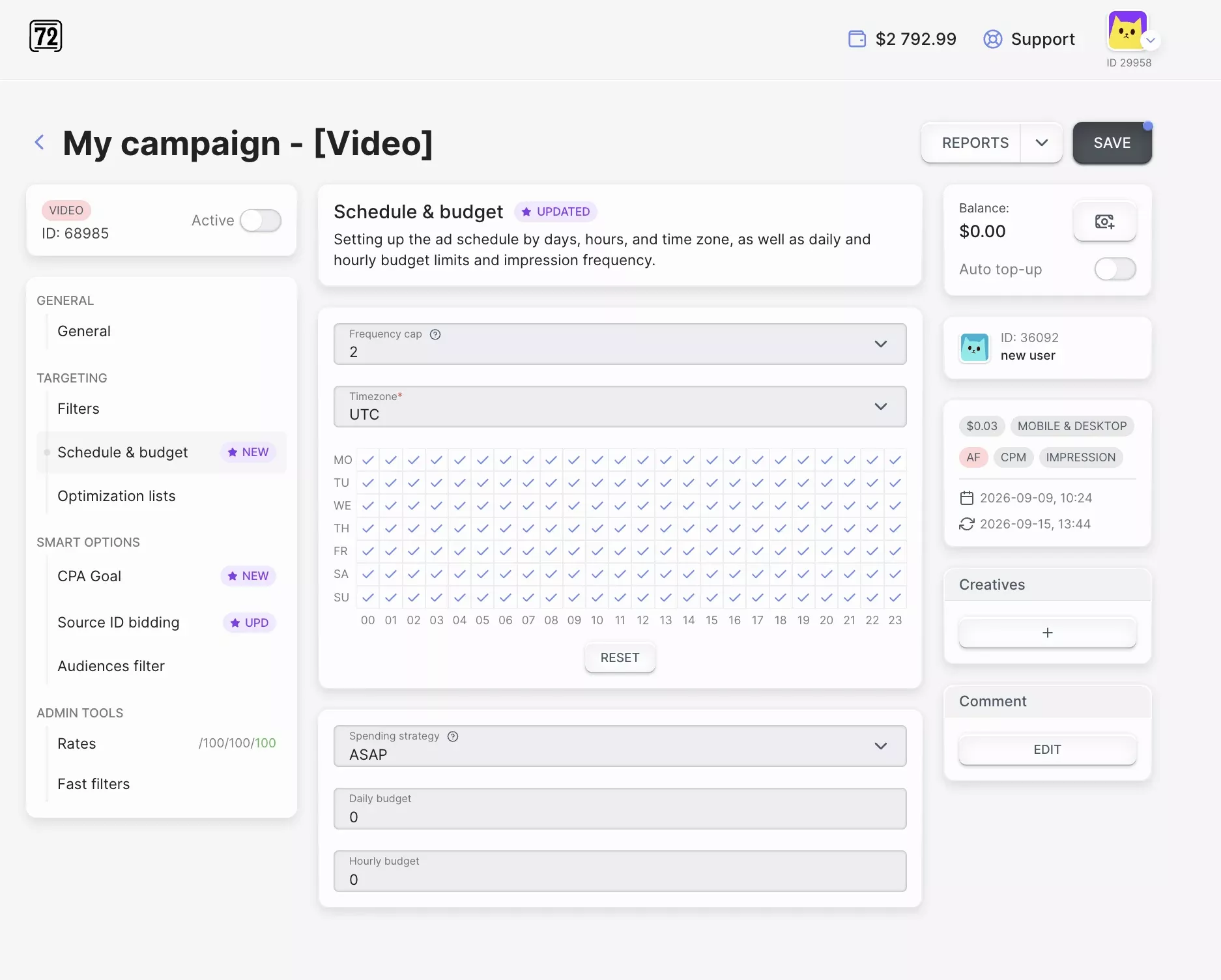
On larger campaigns I lift that to five once a source brings more than 10 conversions a day on under $10 of daily spend. That bar suits high-volume sources, so on a list of a few hundred people the opening cap is usually the one that stays.
Take people who already converted out of the rotation. A pixel on the page that follows registration, and another after a top-up, each carry their own audience parameter, so those groups become segments the campaign can exclude. On a narrow geo the saving shows up fast, because the same small pool is bought over and over.
Retargeted inventory on the ADMY exchange costs the same as those formats bought on broad targeting, with no premium for the warm audience. The pool sets the scale of the spend: a few hundred people carry a small budget, and the figure grows with the list.
Local Retargeting with ADMY
ADMY runs local retargeting as a managed service. The pixel goes on your site, the strategy, creatives and campaigns stay on the ADMY side, and each group on the list gets its own offer instead of one banner for everyone. You get a separate admin panel, and launch takes two to three days.
The pixel matches people on the IP address and user agent from the bid request Browser limits on cookie lifetime leave the list alone, because there is no cookie to expire. Segments come from separate pixels, one per page that matters, each with a parameter naming its audience.
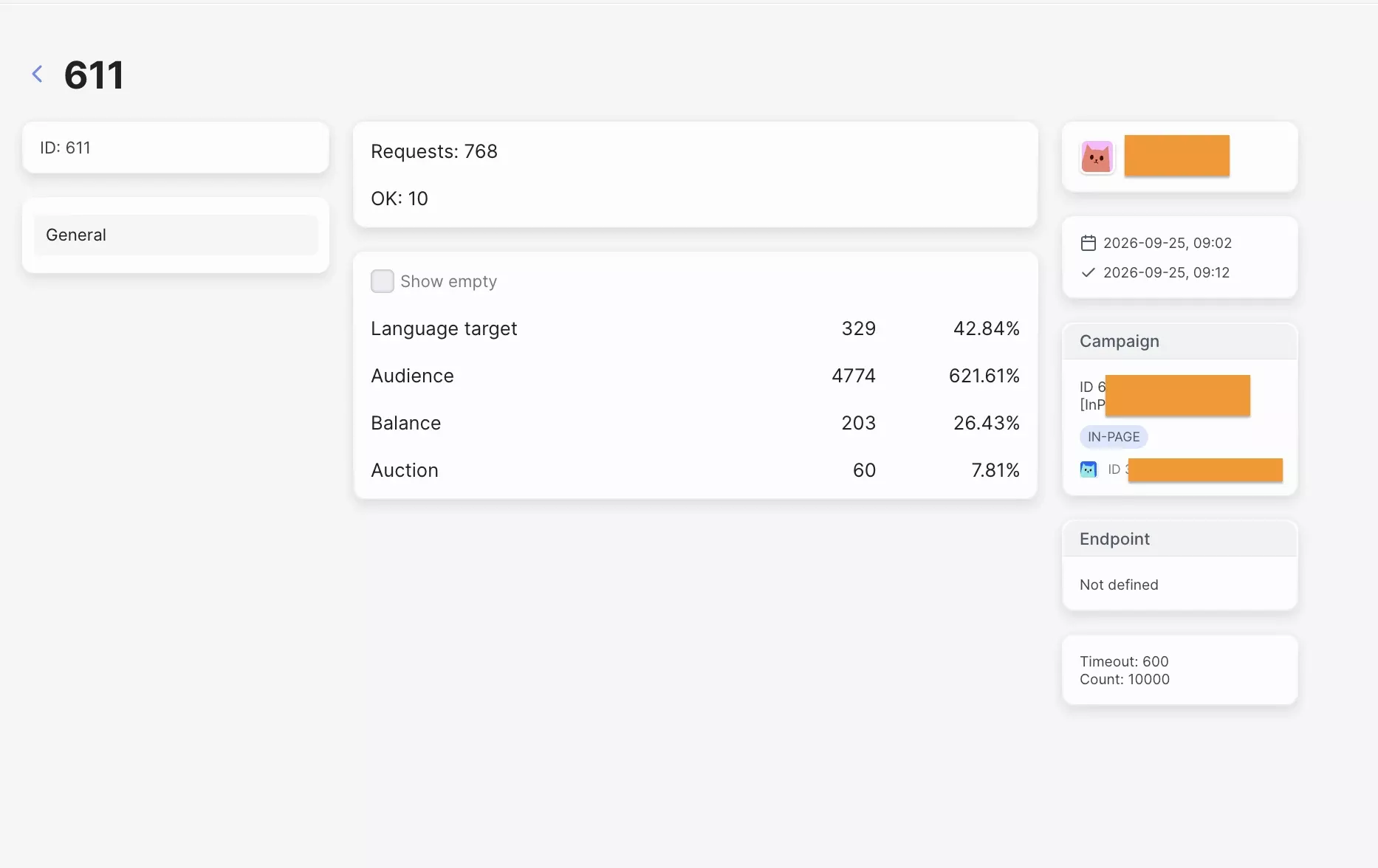
Geo targeting works at three levels: country, region or state, and city, resolved from the same IP address, with no radius option. Inventory comes from the ADMY publisher hub, and any publisher you name can be integrated alongside it. To reach inside one city, that second option is the one to ask about.
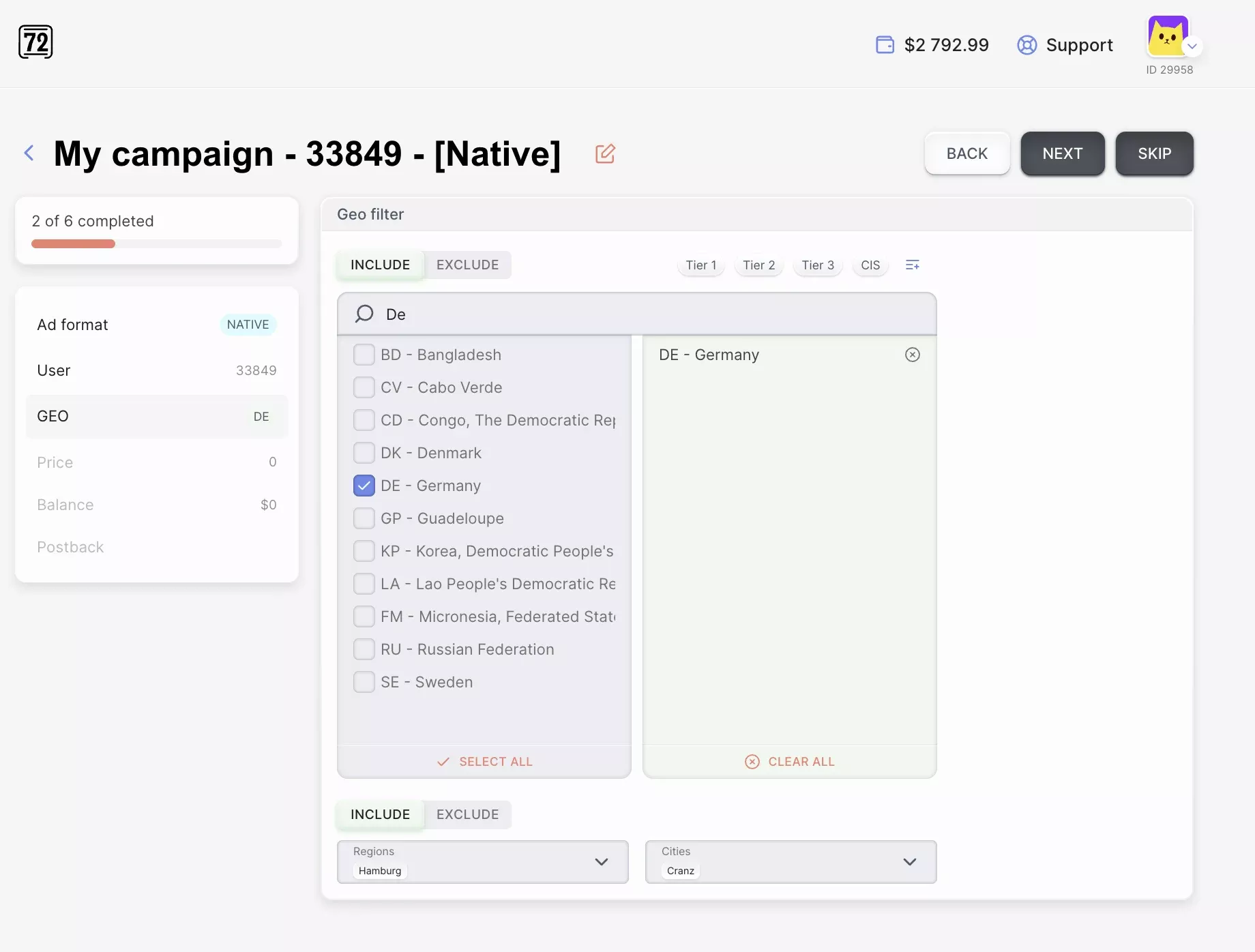
When a campaign runs at lower volume than expected, the first thing I open is the campaign analysis report in the ADMY panel. It shows how many requests each filter let through on the way to the campaign. On tightly targeted setups that answer arrives faster than any change to bids or creative.
If your site draws enough visitors to hold a list above the platform floor, local retargeting is worth a test and I can size it with you. The retargeting services page shows how the managed setup works end to end.
Frequently asked questions
How accurate is IP-based geo targeting on mobile and VPN traffic?
A mobile carrier can route a session through a gateway in another city, and a VPN resolves wherever its exit node sits, so both land in the wrong place. How often it happens moves with the market and with the share of mobile traffic a site gets. Treat city-level reporting as close rather than exact.
Do I need consent before the retargeting pixel fires?
In the EU the ePrivacy Directive and in the UK the PECR regulations require consent before advertising identifiers are set. A correctly configured banner holds the pixel until the visitor agrees. United States rules differ by state, and California's CCPA and CPRA work on an opt-out basis.
Does a new pixel pick up visitors from before it was installed?
No, collection starts the day the pixel goes live, and earlier traffic leaves no record to work from. A list therefore needs a few weeks of runway before a campaign has anything to serve. Put the pixel up first and plan the launch around it.
What happens to someone on the list who travels to another city?
They stop matching the campaign while they are away, since location is read at the moment of the bid rather than stored with the visitor. When they come back, they match again. Nothing is lost from the list itself.
Can a list built for one market be reused in another?
No, because the list is made of people who visited from that market, and moving the campaign elsewhere leaves it pointing at the wrong audience. Each market needs its own list, built from its own traffic. The setup carries over, the people do not.
Can the same visitor end up in two segments at once?
Yes, each pixel fires on its own, so someone who loaded two tagged pages joins both lists. Exclusions settle which campaign reaches them, which is why the order of those rules matters more than the number of segments.

More articles
 Iliya Dowlasov