iGaming retargeting brings players back by matching each one to the exact step they dropped off at: visited but never registered, registered but never deposited, or deposited and then went quiet. Each group fires its own pixel event and gets a message built for that exact stage, never a generic one aimed at all three at once. That's the setup ADMY runs on the exchange side: iGaming retargeting delivered as a managed service, segmentation built in.
EN
RU

Retargeting vs Retention vs Reactivation: What's the Difference
Retargeting, retention and reactivation are three different points on one funnel, not three separate campaigns run in parallel. ADMY ties each to a specific pixel event instead of treating every iGaming player as one audience.
| Funnel stage | Pixel event | Message focus | Example message |
|---|---|---|---|
| Visited, never registered | event=visit | Bring them back to finish sign-up | "Finish setting up your account, it only takes a minute" |
| Registered, no deposit | event=reg | Push toward the first deposit | "Your welcome bonus is still waiting, fund your account to claim it" |
| Deposited, now inactive | event=deposit | Retention or reactivation, depending on how long they've been gone | "We've missed you, here's something new since your last visit" |
The event parameter itself carries no timestamp beyond the moment it fires. How long ago a depositor went quiet gets decided by the campaign's targeting window, not by the pixel itself. Retention here means a depositor who went quiet recently and likely still remembers the brand; reactivation means one gone long enough that a plain reminder probably won't bring them back, so the offer needs to carry more weight. ADMY doesn't fix a single day count for where that line sits, since how long is too long depends on how often a given brand's own players normally return.
A single banner shown to everyone who ever visited ignores this split. Someone who never signed up has no use for a deposit bonus message, and a depositor who already funded an account has no use for the sign-up pitch. The platform builds a separate tested creative for each segment instead, matched to whatever touchpoint a player already had with the brand.
Retargeting matters in iGaming because bringing back a visitor who already registered, or a player who already deposited, costs less than acquiring a brand-new sign-up from scratch. That is also why it runs alongside acquisition rather than only after it: the three segments keep filling while acquisition campaigns are still live.
How to Segment iGaming Players for Retargeting
ADMY segments iGaming players by the funnel page they reach: a separate pixel fires on each page, tagging a visitor into one of three base audiences, visit, reg or deposit. Which audience a visitor lands in starts with that placement, not with anything inferred about behavior.
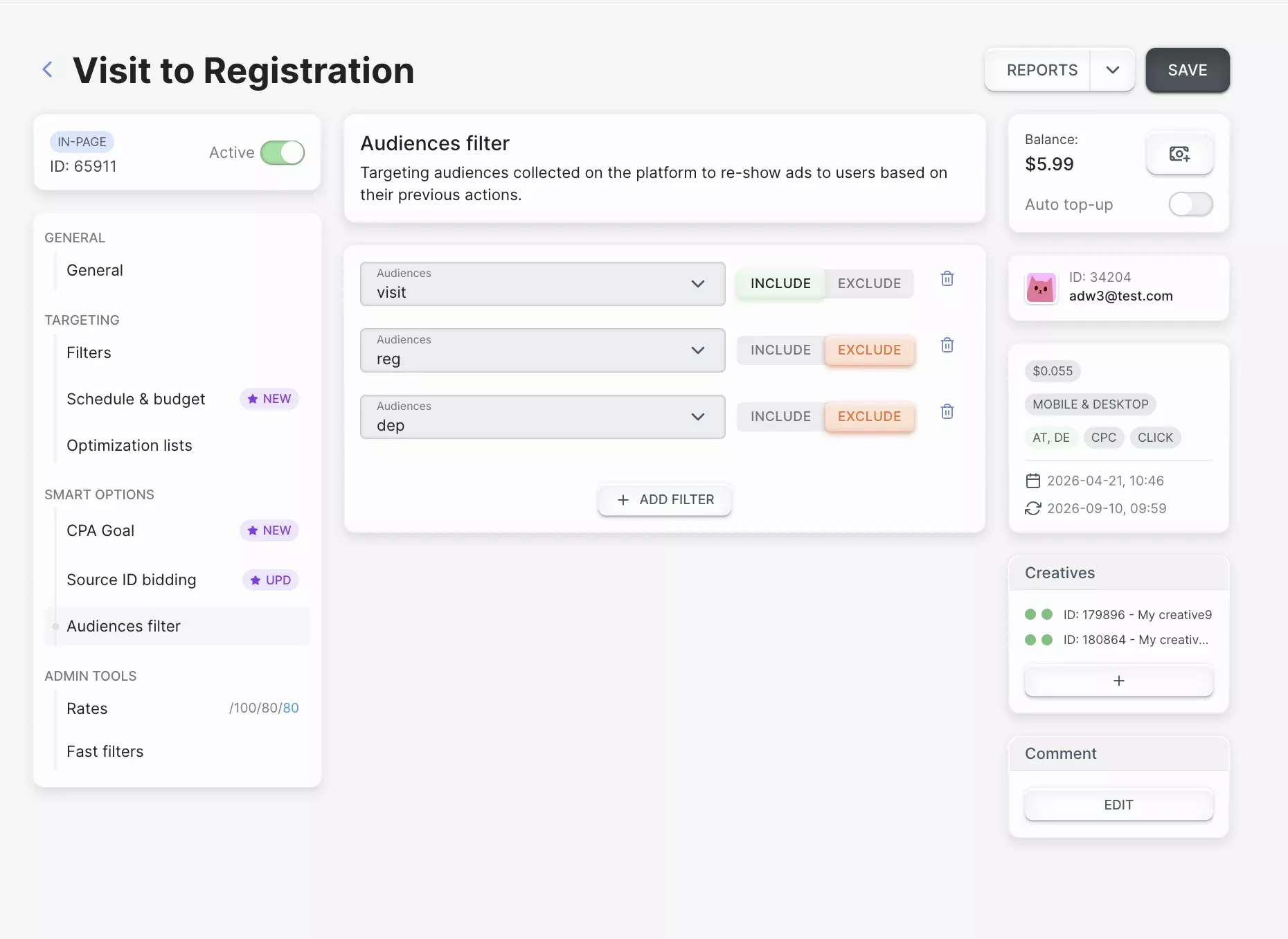
A campaign then combines those audiences with include and exclude rather than stopping at whichever pixel fired first. The visit-stage campaign targets visit while excluding reg and deposit, so a player who registers drops out of it automatically instead of still seeing a sign-up reminder.
All three audiences depend on the visit segment filling first, and a brand whose site draws too few visitors never gets past that point. Search retargeting is the alternative there, because its audience comes from queries typed on other companies' sites rather than from visits to yours, so it reaches players before the pixel has anything to record.
Cookieless Retargeting: How the ADMY Pixel Matches Players
The ADMY retargeting pixel matches players without cookies, recording only two values when it fires on a page: IP address and user agent. Those two values are then matched against the same fields in a later bid request. The pixel doesn't log page views, session length or which games a player looked at, and that scope can't be widened per client.
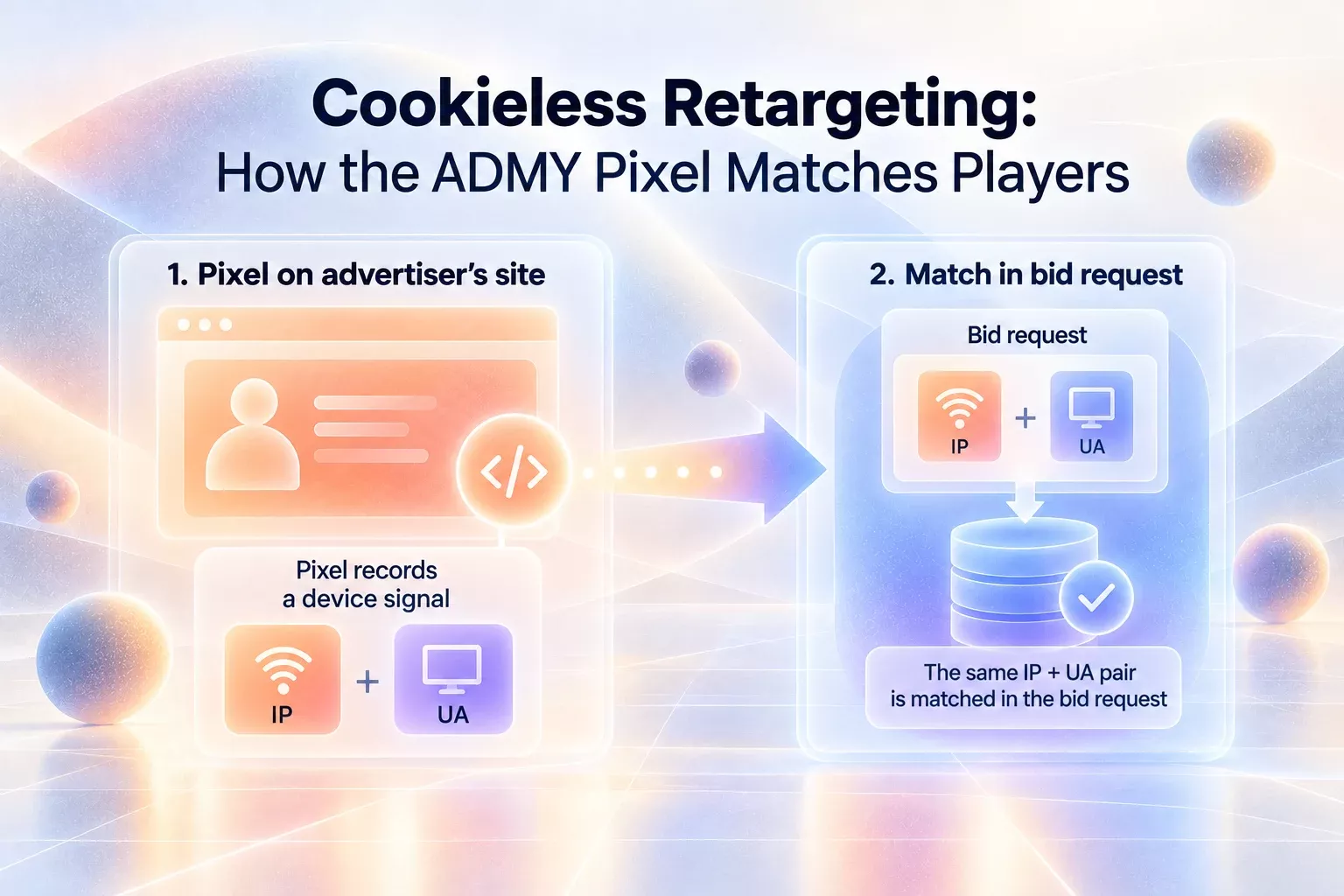
A consent banner or a browser that blocks third-party cookies has no effect on this matching, because no cookie is ever set. That's the edge it has over a cookie-based setup, which loses its audience the moment iOS or Safari clears cookies. The one place it gives something back is shared IP addresses, such as office networks or some mobile carriers, where several people behind one address make matching less precise.
Where iGaming Retargeting Ads Run
iGaming retargeting ads run through the ADMY exchange in the same real-time bidding auction as any other campaign, across six formats: pop, push, in-page, native, video and banner. What changes with retargeting is the audience a campaign targets, not the programmatic advertising underneath it: the auction, the bid request and the formats all stay the same.
Most mainstream ad platforms restrict gambling creatives outright, so iGaming retargeting runs through exchanges whose publishers accept this vertical. Those publishers make up a subset of the exchange's total inventory, and a campaign's reach depends on how many of them a given traffic source has connected.
How to Set Up an iGaming Retargeting Campaign
An iGaming retargeting campaign goes live in five stages, and ADMY runs most of them from the exchange side. The client's own part is limited to the first stage, adding the pixel to the site.
- Place the three pixel calls. On signed-out pages, on the page after registration, and on the page after a deposit confirms.
- Let each segment fill with real visitors before launching messages against it, since a campaign against an empty segment has nothing to show.
- Build and test one creative per segment: a sign-up reminder for event=visit, a first-deposit offer for event=reg, and a returning-player offer for event=deposit.
- Launch each segment at 2 impressions per player per day.
- Raise the cap to 5 for any source that passes the conversion threshold, and leave the rest at the starting cap.
The client watches all five stages from the admin panel without configuring any of them: segment size per event, impressions and spend per source, and conversions coming back through the postback. That panel is the same one used for campaign analysis once the segments are live.
The Frequency Cap for Retargeting Campaigns
ADMY sets no frequency cap by default, but retargeting campaigns for iGaming brands start at 2 impressions per player per day. That cap rises to 5 once a source proves itself: specifically, once it brings more than 10 conversions a day while the total daily spend on it stays under $10.
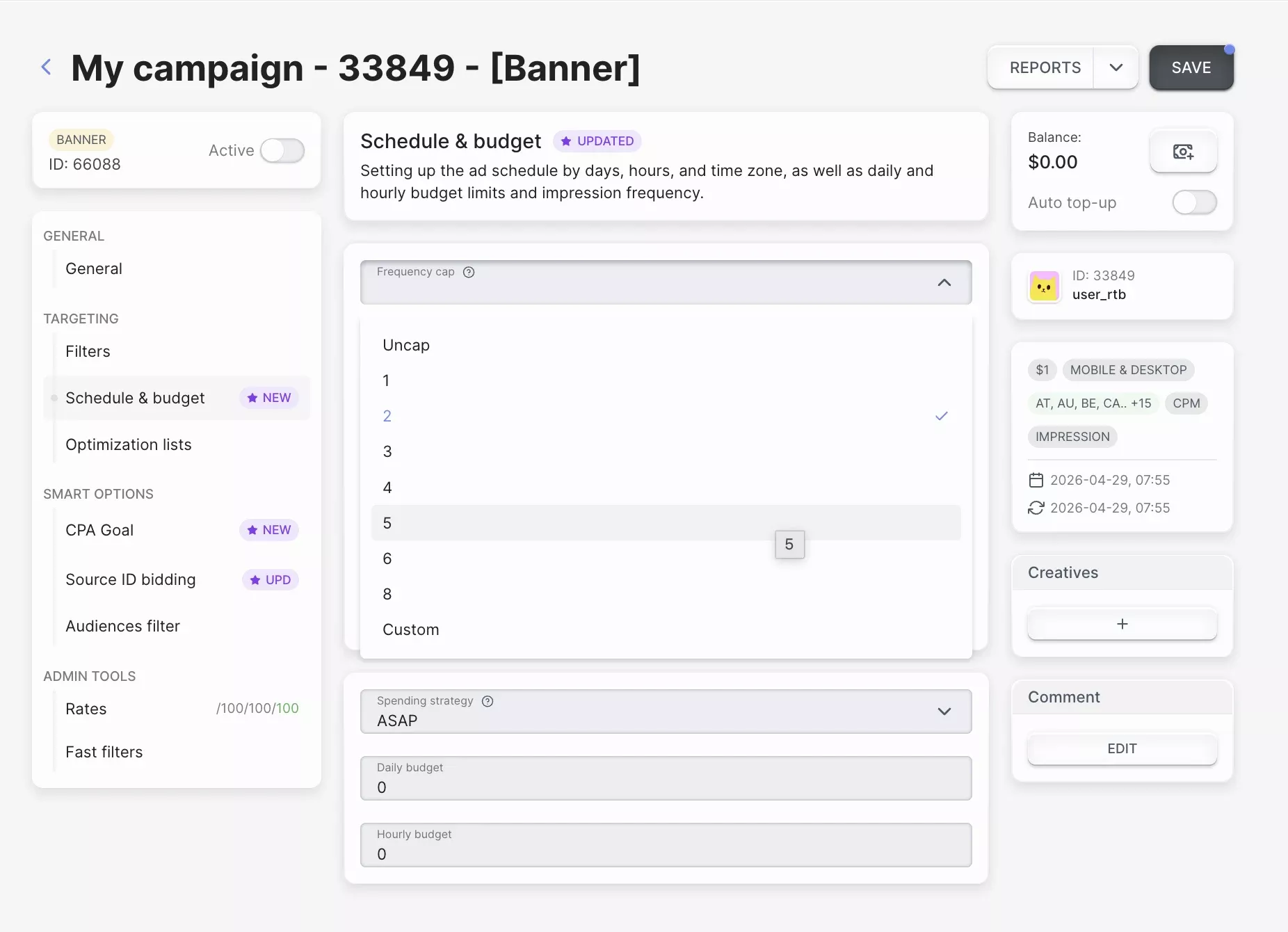
Starting conservative matters more here than in most other verticals, since players already see offers from several brands in the same session. An ad that shows 5 times a day from day one reads as pressure, not a reminder, so new sources stay at the lower cap until they prove themselves.
What a Full-Cycle Retargeting Service Includes
An iGaming retargeting solution from ADMY covers strategy, creative, the pixel and campaign management in one package, the same five-stage setup described above but run entirely from the exchange side. A brand doesn't need an in-house team to build any of it.
A brand can go live within 2-3 days of the pixel going on their site. The setup errors I actually see come from partners who license a white label DSP to run their own network rather than use the managed service, and most of those trace back to the postback rather than the pixel.
Retargeted inventory on the exchange costs the same as broad targeting, with no premium for a warmer audience. That holds across all six formats, not just the cheaper ones.
Which Metrics to Track for Each Retargeting Segment
Each segment needs its own metric, because a visit-stage campaign and a deposit-stage campaign answer different questions. The two groups below split the same way the rest of this page does: everyone still short of a deposit on one side, depositors on the other.
Visit and registration segments
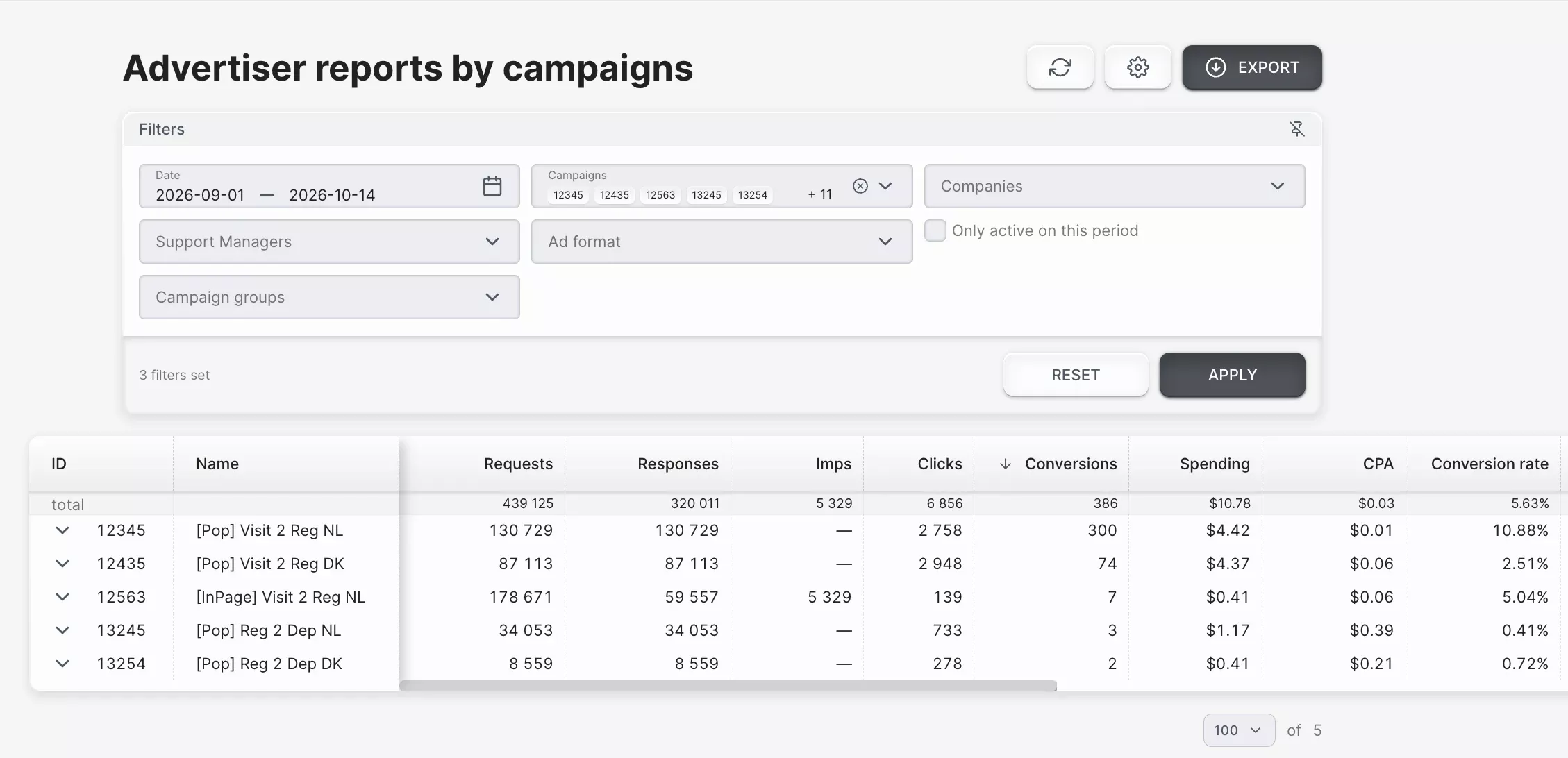
For visit and registration audiences, the number that matters is conversion rate to the next step, registration or first deposit. Revenue-based metrics don't apply yet at this stage, since neither group has spent anything.
Deposit segments
For depositors, it's the repeat-deposit rate and the cost of each repeat deposit. Cost per conversion and frequency matter across every segment, since together they show when a source stops paying back.
Responsible Advertising and Player Protection
Responsible advertising rules apply to retargeting exactly as they apply to a first-touch ad, since a returning player still sees an ad for a specific gambling brand. Age restrictions and the operator's own license requirements don't relax just because the viewer has been on the site before.
Self-excluded players
Self-excluded players are the clearest case: the ADMY pixel only reads an IP address and a user agent, so it has no way to check exclusion status on its own. Once that pair is recorded, there is no way to retract it from the match pool. The exclusion check has to happen upstream instead, before the pixel ever fires: gate the pixel call behind the same account-status check the operator already runs to block a self-excluded player from logging in.
Frequently asked questions
Does iGaming retargeting need minimum traffic?
Yes, but the bar is about how fast the visit segment fills, not about total traffic. A site with almost no visitors has nobody who has already seen the brand to retarget, and that's the only reason retargeting doesn't work. Reg and deposit segments always fill slower than the visit segment, since fewer people reach those pages, so plan to launch them a little later.
Can the frequency cap be adjusted per campaign?
Yes. The 2-to-5 progression described above is ADMY's own default recommendation for retargeting, not a fixed limit, and a cap can be set manually on any individual campaign that needs a different number. A brand running several iGaming products at once can set a lower or higher cap per campaign rather than accepting the same default across all of them.
Why aren't some retargeting conversions being tracked?
The most common cause isn't the pixel, it's the postback. A partner's tracker sometimes sends click_id instead of the clickid parameter ADMY expects, and that single typo drops every conversion from that source silently while the campaign looks like it's running fine.
Can an agency run iGaming retargeting for a client?
Yes. Advertising agencies are one of the audiences ADMY builds this for, alongside operators managing their own traffic directly. An agency can set up and manage a client's retargeting campaign through the same turnkey service without building any of the pixel or segmentation infrastructure itself.

More articles
 Iliya Dowlasov