Search retargeting shows your ads to people who searched for something in your category, even though they have never visited your site. Someone types a query on another site, a data partner puts them into an audience built around that keyword, and your ads start showing up as they browse elsewhere. That gives you an audience of people who are already looking for what you offer and have simply not found you yet.
EN
RU

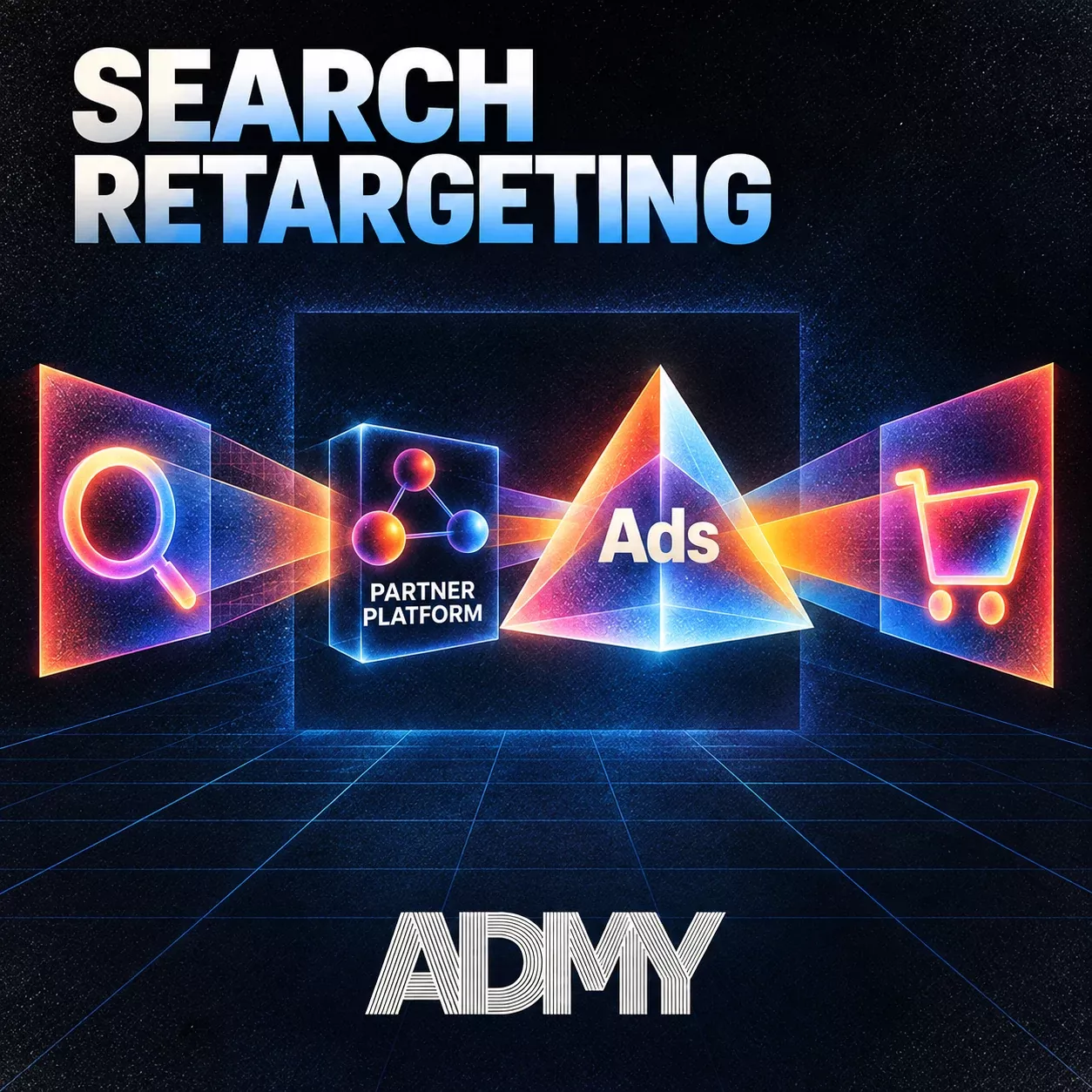
How Search Retargeting Builds an Audience
The audience is built from searches people made on other companies' sites, so a person can join it without ever opening a page of yours. A partner that sees search traffic writes down the query and whatever identifier it can read from the browser, files those identifiers under the keyword, and hands the finished list to a buying platform.
Someone compares sign-up offers after a search, reads two more pages on a review site and closes the tab. To site retargeting that person never existed, because none of those pages were yours. The query is what puts them in a search retargeting segment, so your first ad may be the first time they see the brand name.
Keyword match types in audience lists
Match type changes how many people end up in a keyword audience, and it changes that number far more than the keyword itself does. Exact match takes only the people who typed the phrase as written, which keeps the intent clean and the audience small. Broad match takes anything the partner decides is related, which fills the audience fast and waters it down just as fast.
Phrase match sits between the two, and it is where most keyword retargeting lists end up. Start narrow, see whether the audience fills at all, then loosen the match type one step at a time. Cleaning up a broad audience later is guesswork, because you cannot see which query brought each person in.
How long a person stays in the audience
Match type decides who enters a keyword audience, and the membership window decides how long they stay, which matters more here than it does in site retargeting. A search records a passing intention where a visit records a relationship, so someone who searched a category this morning may have bought by tonight, and an ad shown three weeks later reaches a person whose problem is already solved.
No partner publishes how long a person stays in a standard keyword segment. Cross Pixel comes closest, with a two-hour window on its real-time custom audiences, after which the cookie goes inactive unless the person does something else that qualifies. That covers a different product, but it shows how short these windows get once anyone commits to a number.
ADMY does not sell keyword segments, though the same setting sits on an audience built by its own pixel, where it is called membership duration. Leave it at 0 and a person stays in the audience forever; set it to 14 and anyone who has not triggered the pixel for two weeks falls out.

Fourteen is what I use on most campaigns, 7 when an audience fills quickly, and 0 when a client has so little traffic that losing anyone hurts. I choose by how fast the audience fills, not by how fast interest fades, and a partner selling keyword segments can give you their number the same way.
Search Retargeting vs Site Retargeting
The two tactics differ in whose data builds the audience: search retargeting uses searches made on other people's sites, site retargeting uses visits to yours. Everything else follows from that.
| Search retargeting | Site retargeting | |
|---|---|---|
| What puts a person in the audience | A query typed elsewhere | A visit to your own pages |
| Who owns the data | A third-party data partner | You |
| Funnel stage | Before the first visit | After the first visit |
| Brand familiarity | None assumed | Already established |
| Creative | Category-level offer | The specific page they visited |
| Main risk | Stale or mismatched intent | Too few visitors to work with |
Warm and cold audiences need different creatives, and this is where a campaign copied from one tactic to the other breaks. You can show a returning visitor the exact offer they walked away from. A person who only searched has no history with you, so an ad written as a reminder reads as noise.
Site retargeting does not have to run on cookies either, although most explanations assume it does. The ADMY pixel saves the IP address and the user agent of everyone who visits the client's site, and a match happens when that same pair turns up in a bid request. Advertisers who would rather hand the whole job over can look at ADMY's full-cycle retargeting.
Search Ads, Contextual Targeting and RLSA
Search ads, contextual targeting and search retargeting buy three different things, and only search retargeting uses what a person searched for in the past. Search ads buy the query while it is being typed and show up on the results page. Contextual targeting buys the content of the page someone is reading right now and knows nothing about them.
Remarketing lists for search ads, shortened to RLSA, are the third. They apply your own list of past visitors to your own search campaigns, and a list needs 100 active users from the last 30 days before it can run, a threshold standardised across all networks in December 2024, down from the 1,000 that search campaigns used to require.
Older RLSA guides still print that 1,000 as the current rule, and most of them also cap list membership at 180 days. Both numbers are out of date. The 1,000 survives only for customer lists uploaded before February 2024, and Google's own documentation now lets a person stay on a list for up to 540 days, on search and display alike, checked September 2026.
Widely read explanations equate search retargeting with Google's keyword contextual targeting, and those are separate products. Contextual matching looks at the page a person is reading at that second, so two readers of the same article see the same ad, whatever either of them searched for last week.
Where the Search Data Comes From
The queries come from publisher sites, not from search engines. Google has never released what people type into it, so nobody can sell you Google data, which means the biggest source of search demand in most markets is the one source that is closed. What vendors sell instead is what people do on other companies' websites.
A data partner puts a tag on those sites and records the searches and clicks people make there. Datonics sets out its method in its filing with Adobe's data partner directory: the tag sits on publisher sites, the server accepts the data only when the visitor's IP is in the United States or Canada, and people are grouped by their keyword activity on shopping and review sites. So a large share of what is sold as a search query was typed into a publisher's own search box.
That geography decides whether you can use the tactic at all. Datonics says in the same filing that it takes in no data from GDPR countries and passes none on, so a European campaign cannot buy what the case studies describe.
Most articles on this tactic still describe a method that has stopped working. The data used to come from the referring URL when someone clicked through from Yahoo or Bing, and browsers no longer pass it.
What Search Retargeting Actually Buys
Search retargeting does not buy search engine queries. Google never released them, browsers stopped passing them in the referrer, and the one partner that documents its method collects from publisher pages instead.
Two conclusions follow for a media plan. A European campaign cannot buy the product the guides describe, at least not from the partners those guides name. An American campaign is buying what people do on shopping and review sites, not what they told a search engine, which is a narrower signal and a more commercial one, because a search made inside a site in the category sits a step further along than one typed into an engine.
Buying it splits into two jobs that sit with two different companies. The segment comes from a data partner, whose coverage you have to check market by market, and the ads run on an exchange. ADMY takes raw audience data uploaded into the platform, so a segment bought elsewhere can be used here across the six formats.
Building the Keyword List
A search retargeting keyword list is built around commercial intent, and search volume is the wrong thing to sort it by. A big category term collects students writing papers and competitors keeping an eye on the category along with real prospects, while a smaller term that implies a decision brings fewer people who are each worth more.
A wrong term also costs more here than it would in a search campaign. On a results page it produces one wasted click that shows up in the report, while in a keyword audience it adds a person who keeps collecting impressions for as long as the window lasts.
Commercial queries and research queries
Commercial queries carry a decision, research queries carry curiosity, and you separate them before you buy anything. Comparisons, cost-related terms and anything worded as a decision go in the first group. Definitions, how-to phrasing and plain category nouns go in the second, where they work for awareness budgets and waste money on anything measured by conversions. Vendors selling this as search keyword retargeting will take several hundred terms without a word, so keep the first list short and split it by group.
Ad Formats, Placements and Frequency
The ads appear on ordinary websites after the person has left the results page, which decides both the formats you can use and how often to show them. On the ADMY exchange there are six: pop, push, in-page, native, banner and video. The results page itself is not available to this tactic at all.
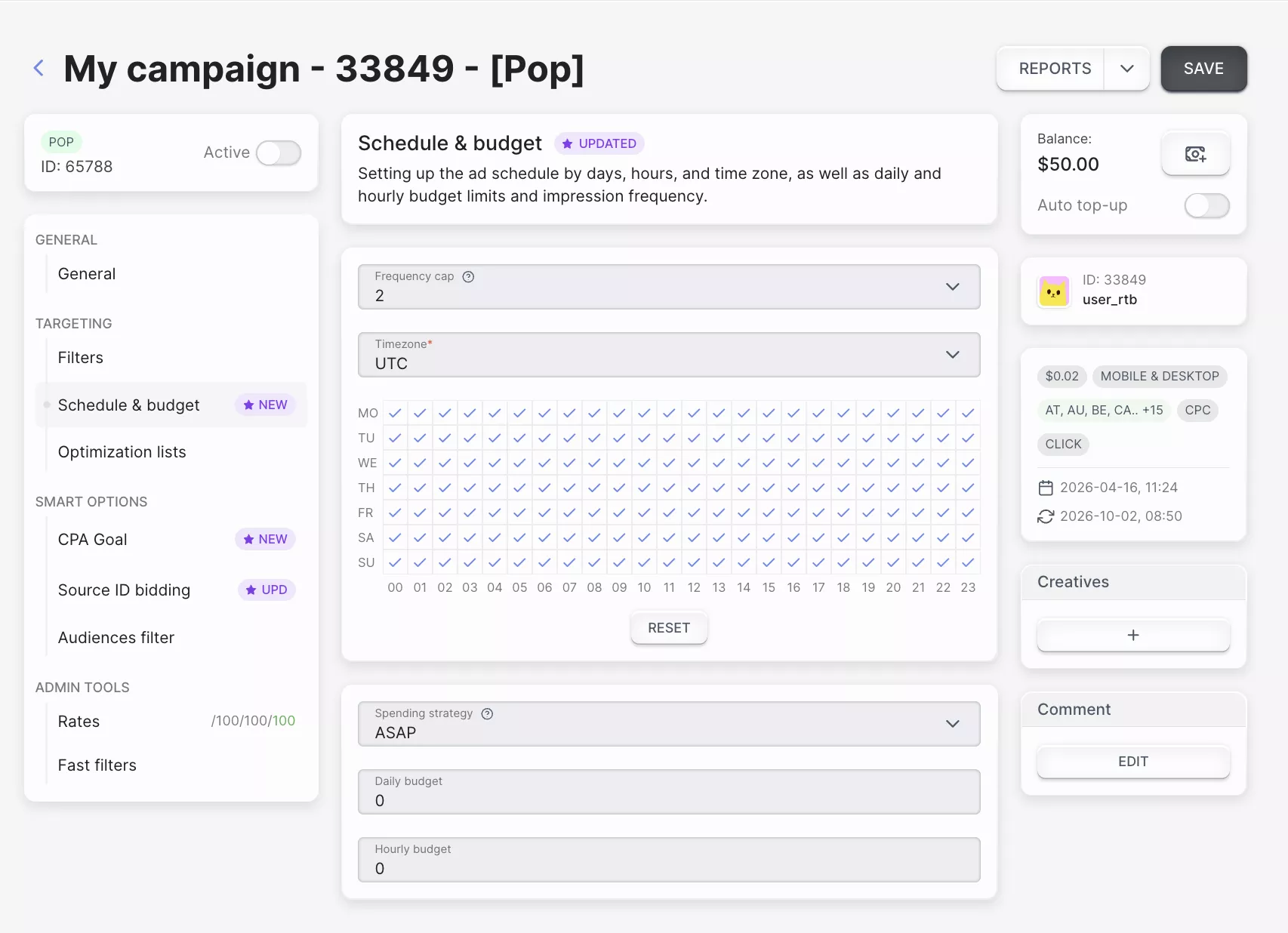
Frequency needs a tighter setting on cold audiences than on warm ones. ADMY sets no cap by default, so it has to be set on the campaign, and on the retargeting campaigns I run I start at two impressions per person per day. I move it towards five only when a source brings more than ten conversions a day at under ten dollars of spend.
ADMY works out location from the IP address at three levels: country, region or state, and city. There is no radius targeting, so a city is the smallest area a campaign can buy, which matters when a keyword points at a neighbourhood rather than a city. Local retargeting built on your own visitors runs into the same floor, so a service area narrower than one city means buying the whole city and accepting the spill.
Limits of Search Retargeting
The creative has nothing specific to show. A query tells you what someone was interested in, not what they did on your site, so what is left is an offer at category level, competing with every other brand showing much the same thing.
Reach depends on the identifier. A cookie-based keyword segment never appears in Safari, which has blocked third-party cookies by default since 2020, or in Firefox, which has partitioned them since 2022, so part of the audience is out of range before the campaign starts.
You inherit consent you did not collect. A segment bought from a data partner rests on whatever legal basis that partner set up, and the advertiser running the ads is the one who answers for it, so ask for that basis in writing before you buy.
Frequently asked questions
Do I need a pixel on my site to run search retargeting?
Not to build the audience, because the data partner assembles it from activity on other companies' sites. You still want one for measurement, since without it there is no way to tell which impressions led to a sign-up, and no way to run a holdout. Treat the pixel as your reporting, not as your targeting.
Can search retargeting target a competitor's brand name?
A brand term can sit in a keyword list like any other, and whether it should is a separate question. Trademark rules differ by platform and by country, and using a competitor's name in the ad itself is treated far more strictly than using it to pick an audience.
Can a European campaign buy search retargeting?
Not from the partners the standard guide's name. Datonics keeps to the United States and Canada, and Cross Pixel's own segment page covers North America and Latin America. A European buy means finding a partner that built its collection for consent rules from the start, and asking for its legal basis first.
Can I build my own keyword segment instead of buying a ready-made one?
Both named partners build custom segments from your own keywords as well as selling packaged ones, so the option exists. It is worth it when your terms are specific enough that no packaged category covers them, and a waste when a standard segment already matches. The trade-off is volume, because a custom set fills more slowly.
Does search retargeting work inside mobile apps?
Apps sell ad space programmatically like any website, but identifying the person is harder there, because apps carry no browser cookies and the original search almost always happens in a browser. Whether that query reaches the same person inside an app depends on what the partner can link together. Coverage drops as a result, so plan for apps to take a smaller share of delivery than the web.

More articles
 Iliya Dowlasov