Programmatic retargeting is the automated purchase of ad impressions, through a real-time bidding auction, that only go to people who already visited an advertiser's site or app. A pixel records a signal on that first visit, the signal becomes a segment, and a DSP bids higher once a bid request carries it. On ADMY's exchange, that signal is a visitor's IP address and user agent rather than a cookie, so there's no list to upload, no extra data fee, and no dependence on what the browser does with cookies.
EN
RU


How a Visitor Becomes a Segment and a Segment Becomes a Bid
A segment is the group a visitor joins once the pixel ties their IP address and user agent to a specific funnel event, such as a visit, a registration or a deposit. A visitor becomes a segment the moment the pixel records that pair on a first visit.
A segment turns into a bid when a bid request, the real-time message an ad slot sends out when it loads, carries the matching IP and user agent to the ADMY exchange, since that's where the matching happens rather than on the demand-side platform's side. The signal-to-segment-to-bid sequence is the same in any programmatic retargeting setup, not just ADMY's. Here's the full sequence:
- A visitor loads a page carrying the pixel, and it records their IP address and user agent.
- That pair gets tied to whichever event fired: a site visit, a registration, or a deposit.
- The visitor later loads a page whose ad slot sells through the exchange, and a bid request goes out for that slot.
- The exchange checks the visitor's IP address and user agent from the incoming OpenRTB bid request against its own pixel data, finds a match, and writes the segment tag onto the request before passing it to connected demand.
- Any DSP running a campaign built for that segment reads the tag and bids; the highest bid wins the slot.
A programmatic retargeting segment usually justifies a higher bid than cold traffic on the same slot, since the visitor has already generated a signal. How much higher is the buyer's own call, set through a manually entered bid line or an algorithm adjusting it automatically, and both compete in the same real-time bidding auction. The same segment can trigger a bid on more than one publisher, since the match is tied to the visitor, not the page where they first got tagged.
What Data a Retargeting Pixel Collects
The ADMY pixel records exactly two values: the visitor's IP address and their user agent. The pixel's scope stops there: page events, form fields, and anything else a retargeting cookie would normally hold all stay outside it. The pixel works entirely without a cookie.
One pixel per funnel stage
Each stage of a funnel gets its own pixel rather than one script that logs every action. I place one on pages a signed-out visitor sees, a second right after registration, and a third right after a deposit, each tagged with its own event parameter. A campaign built around the deposit segment only ever reaches people who fired that specific pixel.
The creative shown follows the same split, matched to what the visitor already did rather than a generic message. The table below breaks down each segment's angle.
| Segment | What the visitor already did | Creative angle |
|---|---|---|
| Visit | Loaded a page, signed out | A general nudge to come back and take another look |
| Registration | Created an account, no deposit yet | A push toward finishing sign-up |
| Deposit | Already converted once | A prompt to act again |
Format stays independent of the segment tag, so a campaign built on any of the three runs in the same six formats as any other: pop, push, in-page, native, banner and video. That consistency means the buyer chooses format by inventory and budget, not by which segment the campaign targets.
What Frequency Cap to Set on a Retargeting Campaign
The frequency cap I set on a new ADMY programmatic retargeting campaign is two impressions per user per day, and it stays there until the traffic source proves itself. A frequency cap is the maximum number of times a single user can be shown an ad within a set period, and on ADMY it is set per campaign. Once a source delivers ten or more conversions a day while daily spend on that source stays under $10, I raise the cap to five.
Setting and reading the cap
Setting the cap is a manual step: the platform's own default is no cap at all, and the auction runs whatever value is entered on that specific campaign. Below the ten-conversion threshold, a higher cap spends through the segment faster than it converts.
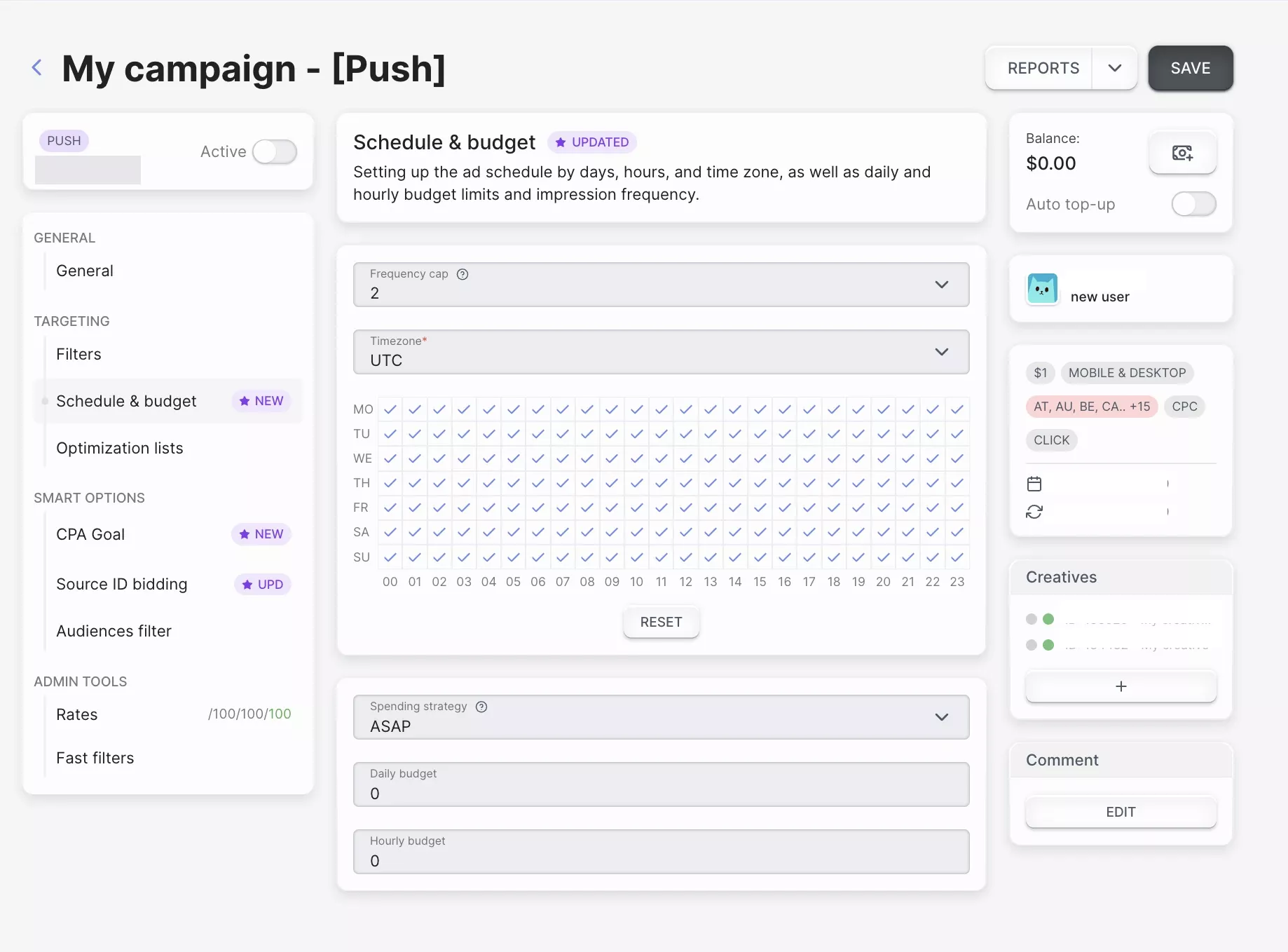
"User" here refers to an IP and user agent pair rather than a person, since the pixel works without a cookie and has no other identifier to count by. When that same pair turns up behind more than one person, its cap gets shared too.
Why IP and User Agent Matching Works Without Cookies
IP and user agent matching has an advantage neither third-party cookies nor uploaded lists share: the signal sits directly on the bid request, independent of anything a browser could take away. The signal keeps working the same way regardless of browser cookie policy, a visitor blocking cookies, or what Google does with its own APIs. The table below compares how each of the three methods holds up against the same set of conditions.
| Third-party cookie | Uploaded list (hashed email) | IP + user agent | |
|---|---|---|---|
| What it needs from the visitor | A cookie the browser accepts | An email address the advertiser already has | Nothing beyond a normal page load |
| Where the match happens | Inside the visitor's browser | At an identity-resolution step, off the bid request | Inside the exchange, on the bid request itself |
| What breaks it | Browser cookie blocking or clearing | A missing or outdated email on file | Shared IPs, IP rotation, VPNs |
| Needs consent to collect | Yes | Yes | Yes, IP is personal data too |
Cookies and uploaded lists both depend on something outside the exchange's control. A third-party cookie needs a browser willing to keep it: as of September 2026, Safari and Firefox block it by default, while Chrome keeps it enabled with no deprecation date, after dropping the phase-out plan in July 2024 and a replacement prompt in April 2025. Cookies aren't the problem because they're disappearing; they're the problem because a buyer's reach on them depends on a policy Google has already reversed twice.
An uploaded list needs the advertiser to have a current, accurate email on file, plus a separate identity-resolution step before it can be used. IP and user agent matching needs neither: the signal comes straight off the bid request, which is why nothing changed for it when Google confirmed it was retiring Privacy Sandbox.
As of September 2026, Google's 17 October 2025 announcement covers ten technologies, including Topics, Protected Audience and Attribution Reporting, with Chrome deprecating them in version 144 (January 2026) and removing them in version 150 (June 2026). Three narrower pieces stayed: CHIPS, FedCM and Private State Tokens.
How Shared and Rotating IP Addresses Affect Matching
The pixel always records the same thing: a visitor's IP address and user agent. What changes is whether that pair matches a record from an earlier visit, and two situations can get in the way: a rotating or hidden IP means a visit misses its match, while a shared IP can produce a false match when a second person behind the same address happens to run the same browser and OS version, since that produces an identical pair.
A mobile carrier can rotate a visitor's IP within hours, and a VPN or iCloud Private Relay can hide it outright. In these cases the cost is just that one missed visit: the visitor re-enters the segment as soon as their IP and user agent match again.
An exact-pair overlap like that is common on a corporate network running a standard machine image, and rare on a home router with mixed devices. Machines sharing one pair this way also share one frequency cap between them. Chrome's narrow IP Protection feature, which masked IP addresses for a slice of Incognito traffic in 2025, was named in the same 17 October 2025 retirement announcement, before it ever left that limited rollout.
Consent Still Applies to IP-Based Matching
Consent rules still apply to IP-based matching because an IP address counts as personal data under GDPR. The Court of Justice of the EU settled that point directly in Breyer v Bundesrepublik Deutschland (C-582/14, 2016). The ADMY pixel therefore sits behind whatever consent the advertiser's own site already collects.
On EEA traffic that means the pixel should only fire once a visitor has accepted tracking in the site's own consent banner. Consent requirements apply the same way whether or not cookies are involved.
Launching a Programmatic Retargeting Campaign
Launching a programmatic retargeting campaign for a new partner takes two to three days, and the steps run like this:
- The client tells me which pages on their site the visit, registration and deposit pixels should sit on, since that choice decides where each segment starts.
- The pixels get set up and tied to segments, so each stage of the funnel starts recording matches as soon as the code goes live.
- The programmatic retargeting strategy and creatives come together next, with each creative matched to the pixel it's meant to follow.
- Campaign management and bidding, including the frequency cap, stay on my side, so the client isn't configuring segments, bid logic or caps.
- The client watches results come in through a separate admin panel.
The client's only real task in that process is step one. Everything after it runs on ADMY's side, including tying conversions back to the campaign through a postback, the same way it works on any other ADMY campaign. A postback is the server-to-server call that reports a conversion back to the exchange, and it's what lets results show up against the campaign built for that segment rather than as a single blended number.
Frequently asked questions
Is programmatic retargeting the same as remarketing?
The terms get used interchangeably, though remarketing sometimes refers specifically to email-based re-engagement rather than ads bought through an auction. Programmatic retargeting specifically means the impression is bought through an open RTB auction rather than booked directly. Retargeting as a category is broader: the same idea runs inside walled gardens like Meta or Google Ads, using their own internal auction rather than an open RTB exchange.
What's the difference between programmatic retargeting and behavioral targeting?
Behavioral targeting reaches people based on general browsing patterns and interests, without requiring any prior contact with the advertiser's own site. Retargeting only reaches people who already generated a signal on the advertiser's own property, such as a visit, a registration or a deposit.
Does a lookalike audience count as programmatic retargeting?
No. A lookalike audience targets people who resemble past converters, with no interaction of their own with the brand, while retargeting only reaches people who already generated a signal of their own. Buyers frequently combine the two in the same campaign, but they draw on different data.
Can programmatic retargeting match the same visitor across their phone and their desktop?
No. Matching runs on the IP address and user agent from a single device and browser, so a visitor's phone and their desktop produce two different pairs and can land in two different segments, or none at all. There's no cross-device identity graph behind it, only what shows up on that one bid request.
Does the pixel need consent outside the EEA too?
The pixel and the matching itself work the same everywhere; what changes is whether local law requires consent before it fires. UK GDPR and California's CPRA and Brazil's LGPD all treat an IP address as personal data too, and the EU's ePrivacy rules add a separate consent layer of their own. I'm not giving legal advice here; these are the regimes worth checking before a campaign goes live in that market.

More articles

 Iliya Dowlasov