You build a retargeting strategy in four moves: pick one goal, split past visitors into audiences, give each audience its own offer and measure each audience separately. The audiences are defined by the last action a user took on the site. Each audience gets its own pixel, so visitors, new sign-ups and lapsed paying users sit in three separate lists. The payoff is ad spend aimed at the people closest to the next step.
EN
RU

Pick One Goal per Retargeting Strategy
One retargeting strategy works best with one business goal, because the goal decides who sees the ads, what the ads offer and which number shows success. In retargeting work at ADMY, a programmatic advertising platform, the usual goals are a finished sign-up, a first top-up and the return of a paying user who has gone quiet.
Each goal needs its own audience and pays off at its own speed. With a separate campaign for each goal, the report shows a separate cost per conversion. You see exactly how each group responds.
A practical way to plan a retargeting strategy is to write the goal down as one action the user has to take. The same action sets the starting layer. A sign-up goal starts from signed-out visitors, a first top-up goal from registered users and a return goal from paying users who went quiet.
Retargeting Funnel: Three Audience Layers
A retargeting funnel sorts past visitors into three layers by the last step they took on the site: a visit, a sign-up or a top-up. With every new step a user should move one layer down and leave the previous one. Someone who registers then drops out of the visitor layer, so nobody sees a sign-up ad after signing up. This rule is known as suppression.
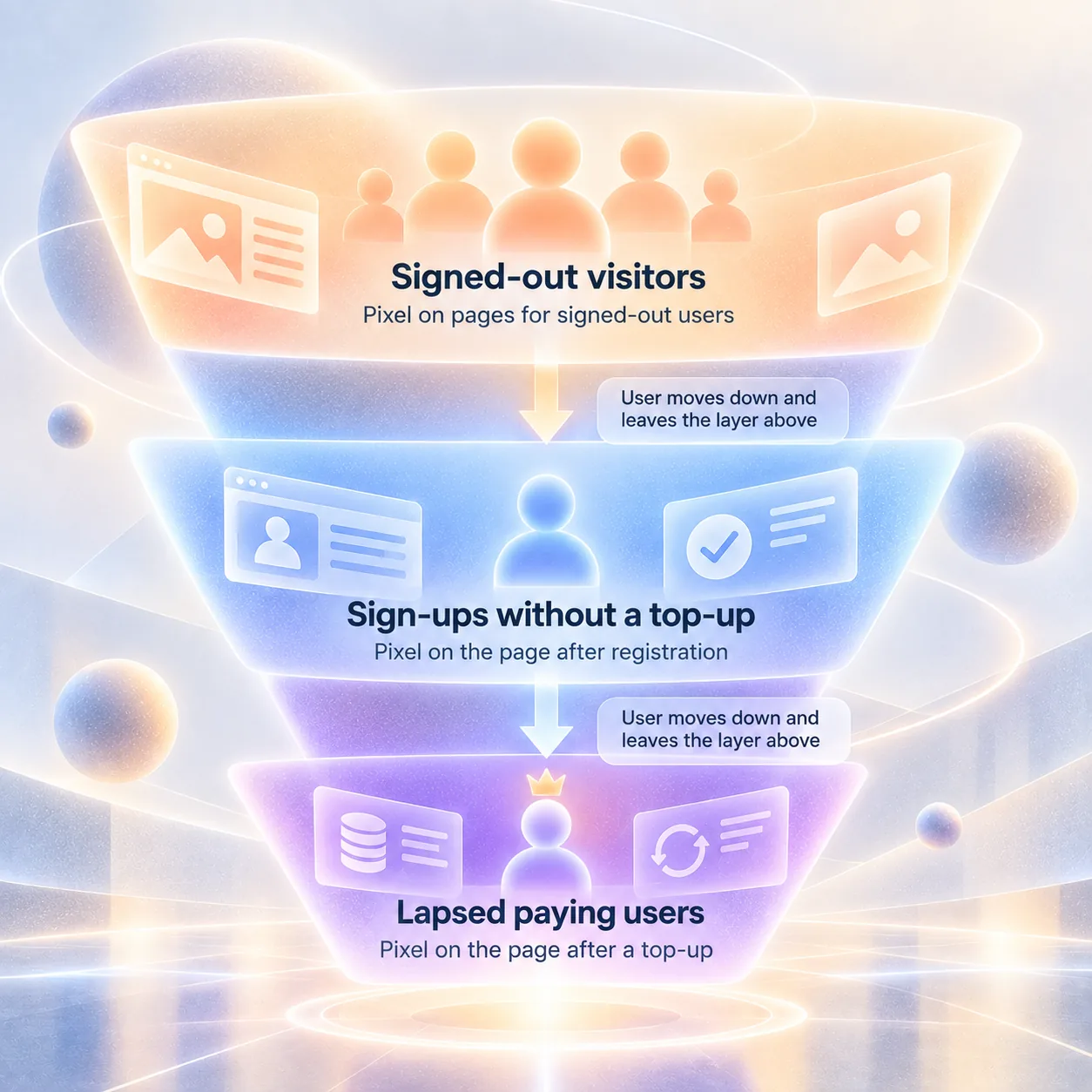
On ADMY each layer is filled by a separate pixel on the page that follows the step. The visitor pixel sits on pages seen by signed-out users, the sign-up pixel on the page after registration and the top-up pixel on the page after a top-up.
Three settings change from layer to layer: the offer, the window and the metric. These are the retargeting tactics inside one retargeting strategy. Each window comes from the brand's own analytics, as the usual time between the step a user took and the next one, and the table below sums up all three settings.
| Layer | Offer | Window | Metric |
|---|---|---|---|
| Signed-out visitors | Reason to register | Shortest | Cost per sign-up |
| Sign-ups without a top-up | First top-up offer | Longer | Cost per first top-up |
| Lapsed paying users | Reason to return | Longest | Share who top up again |
Signed-out visitors
Signed-out visitors saw the product and left before registering. The brand already paid to bring them to the site once, and retargeting gives that visit a second chance to end in a sign-up. The ad for this layer repeats the main promise of the product and leads straight to registration.
A visitor from yesterday still remembers the page, while a visitor from several weeks ago is close to cold traffic, so the window for this layer is short. To check the layer, compare two numbers: the cost of one sign-up from retargeting and the cost of one sign-up from new traffic. If retargeting brings sign-ups cheaper, the layer earns its budget.
Sign-ups without a top-up
Registered users without a top-up have already shared their details, and only the first payment is left. The ad for this layer talks about that payment: the welcome offer and the payment methods available to the user. A user who registers today can come back to pay several days later, so the window is longer than for visitors. If many users register but few make a first top-up, this is the layer to put more money into.
Lapsed paying users
Lapsed paying users are existing customers who topped up at least once and then stopped coming back. They already know the product and have shown they are willing to pay, so each return adds to lifetime value with no new acquisition cost. The ad gives them a reason to come back now, such as a fresh offer or a reminder about an unused balance.
The window here is the longest of the three, and users who topped up recently stay out of the layer because they are still active. The layer works when lapsed users top up again within the window.
Offer per Layer and Format Tests
The offer for each layer follows from the action the user skipped. A creative built around that action uses the main advantage of retargeting: knowing exactly where the user stopped. Research by Lambrecht and Tucker found that ads with specific product details worked worse than general brand ads until users had narrowed their choice, so the message has to fit the stage the user reached.
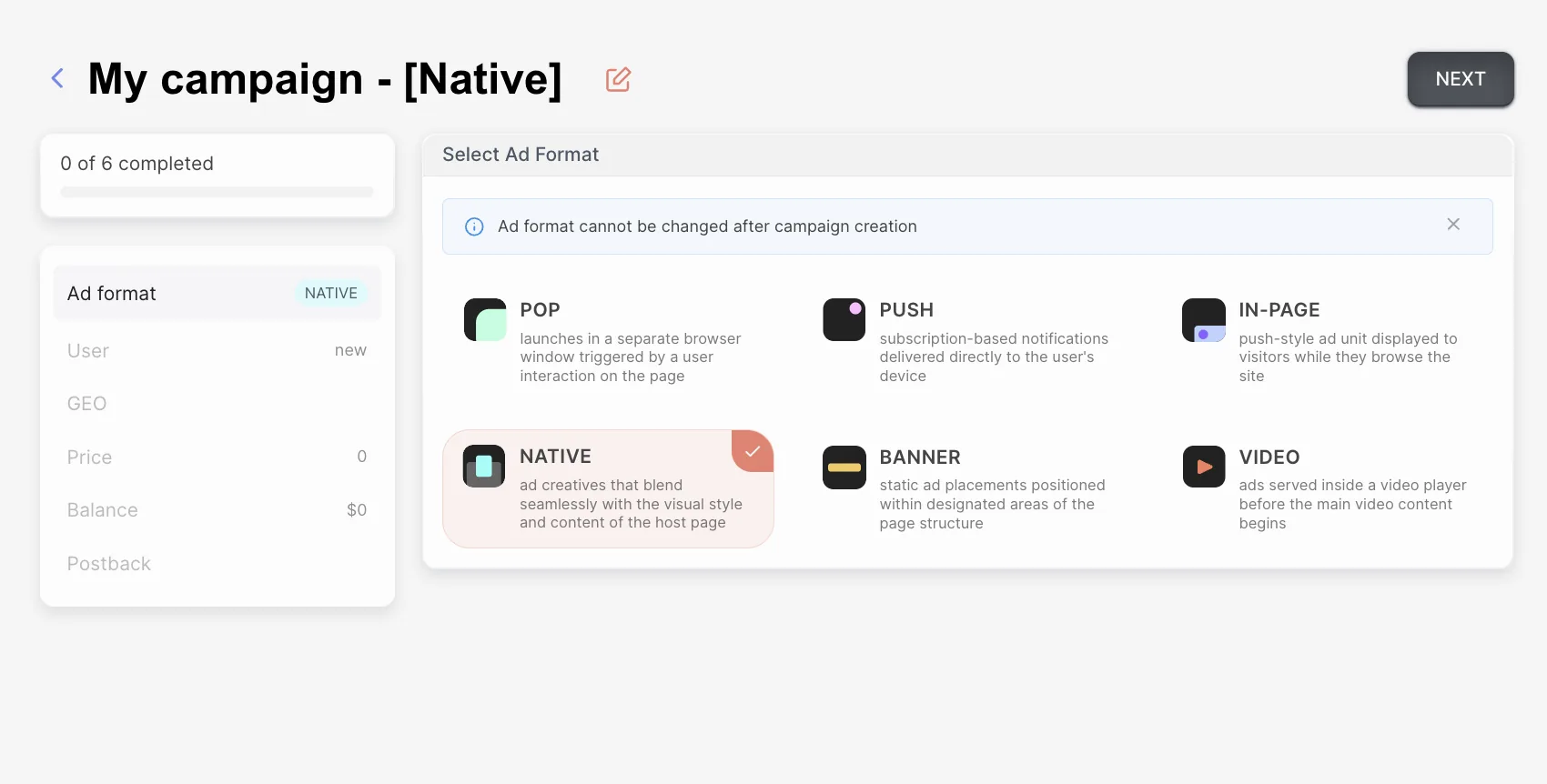
In ADMY Retargeting the creatives are drawn and tested for the client, and each group of users sees its own offer. The ads run in six formats: pop, push, in-page, native, banner and video. The best format for a layer shows up only in a test, so a sensible start is to run several formats and keep the ones that bring the layer's target action at the lowest cost.
How to Run a Retargeting Campaign
To run a retargeting campaign, you place the pixels first, let the audiences fill and only then switch the ads on. The order matters because a campaign aimed at an empty audience shows nothing.
With ADMY full-cycle retargeting the pixel, the strategy, the creatives and campaign management stay on our side. The client gets a separate admin panel, and the launch takes two to three days. The work goes in this order:
- Check site traffic. Retargeting can only bring back people who came, and daily unique visitors times the window in days gives the upper limit of a layer. If traffic is too low to fill the layers, the first budget goes into prospecting, or into search retargeting, which builds its audience from queries typed on other companies' sites.
- Place a pixel with its own parameter on the pages of each layer.
- Connect the postback. Sign-ups and top-ups then reach the platform and count toward the right layer.
- Let the audiences fill before the ads go live.
- Launch each layer as a separate campaign with its own creative and frequency cap.
- Move budget between formats inside each layer once the first conversions come back.
Measuring Results by Layer
A retargeting strategy is measured layer by layer, because each layer has its own target action. The postback sends each conversion to the campaign of its layer, so the result of every layer stays a separate number.
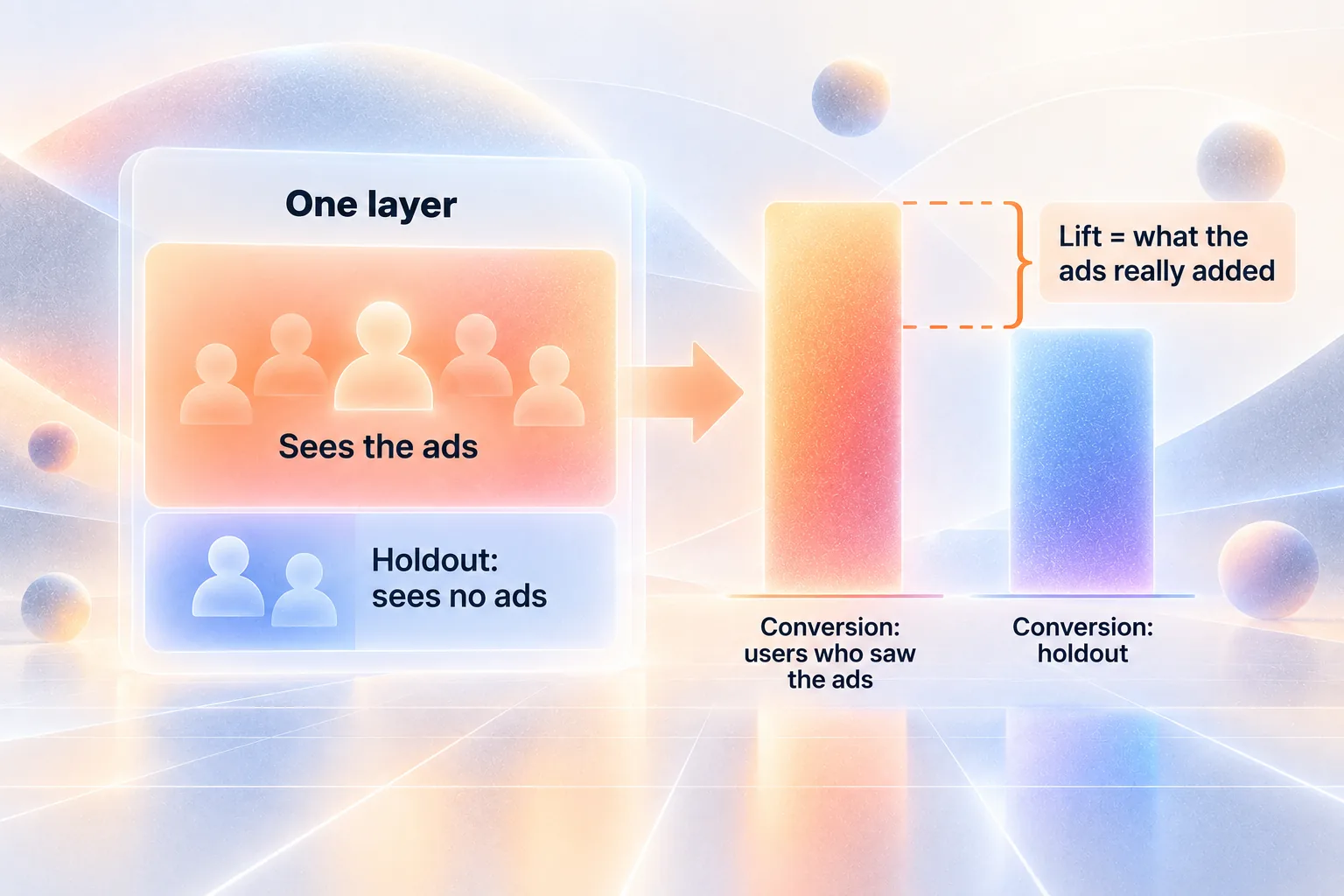
Each of these numbers needs a check, because users in every layer already know the site and some of them come back on their own. The first check is to count conversions after a click and treat view-through conversions with care, since a view alone says little about what the ad did. The second check is a holdout, the standard incrementality test: a random part of the layer that sees no ads.
The difference in conversion between the holdout and the users who saw the ads is the lift the campaign created. A separate holdout in every layer tells more than one shared holdout, because lift on cold visitors and lift on lapsed customers can differ a lot.
Retargeting Best Practices for Scaling
Retargeting best practices for scaling start with the frequency cap: 2 impressions per user per day at launch, and 5 only after a source proves itself. The ADMY platform has no cap by default, so I set it by hand on every retargeting campaign. Starting at 2 keeps the ads from wearing users out. I raise it to 5 when a source brings more than 10 conversions a day at under $10 a day in spend.
After the cap, a retargeting strategy grows through new sources. A higher cap shows more ads to the same people. A new source finds people from the layer that the current sources never reach. On ADMY a client can run its own publisher hub and connect the publishers it picks, which is the quickest way to add sources.
As a layer grows, the same people see the ads more often, and a creative that won at the start loses response. A drop at an unchanged frequency is the signal to put a new version in. The new version changes one element, for example the headline, so the result shows what that change did.
Frequently asked questions
Should retargeting share a budget with prospecting?
Retargeting and prospecting work best with separate budgets. Retargeting looks cheaper per conversion because its audience is warm, so a shared budget slowly drifts toward it. Prospecting then brings fewer new visitors, the retargeting pool shrinks, and on ADMY a small pool is the one case where retargeting stops paying off.
Can one strategy run across several ad networks?
One strategy can run on several networks, but each network counts frequency on its own. A daily cap set on one network does not limit ads bought on another. When the same layers run in two places, the daily frequency is best split between them.
Does a retargeting strategy work without a sign-up step?
A retargeting strategy works without a sign-up step, with two layers instead of three. For a product people buy without registering, the layers are visitors who left and buyers who went quiet. An online store can add a middle layer of shoppers who abandoned a cart, and each layer still gets its own pixel.
Can a retargeting strategy target a specific country or city?
Retargeting campaigns on ADMY can target a country, a region or state, or a city. The location comes from the visitor's IP address, and there is no radius targeting, so a city is the smallest area a campaign can buy. Each geo split makes every layer smaller, which is why city targeting suits brands with enough local traffic.
Does each ad format need its own creative?
Each ad format needs its own version of the creative, while the offer stays the same inside a layer. A push ad is a short title with an icon, a pop ad opens a full landing page, and a banner has to work in fixed sizes. The message is adapted to the space each format gives.

More articles
 Iliya Dowlasov